Episode 5. Animals during the war
“Either we save ourselves together, or no one goes anywhere” – this is the leitmotif of this episode. The stories of people and animals who left the shelling behind through checkpoints, evacuated into the unknown across faraway lands, crossed half of Europe, and even fought on the frontlines. About humanity, perhaps in its purest manifestation, and mutual devotion.
Епізод на інших платформах:
Текстова версія:
“Either we get to safety together or no one is leaving at all” is a through line of this episode. Stories of people and animals who fled under fire, through checkpoints, evacuated into the unknown far, far away, drove through half the Europe and even fought on the front lines. On humanity, probably, in its purest form and mutual devotions.
Patron the dog has his own Wikipedia page, presidential medal “For Dedicated Work”, awards from Cannes Film Festival, Irish Kennel Club and US veterans. Stepan, a cat from Kharkiv with a million Instagram followers, left Pivnichna Saltivka for France where he received blogger’s “Oskar” and raises tens of thousands to help his less fortunate fellows in Ukraine. Miss Bulochka, the kitty of the head of Come Back Alive foundation, already has over 20 thousand followers on Twitter, where she simply looks pretty and subtly promotes the work of the foundation.
Animals, as well as children, always were mandatory frills on news broadcasts of sociopolitical channels. It’s an evergreen topic of jokes among media professionals.
— National Guard saves 21 dogs from kennel in Luhansk region
— Fleeing the war, people from Kharkiv evacuated over 70 cats in a truck
— Shelter in Lviv welcomed two thousand animals in the first month and a half of the war
These are random titles of news reports.
During the war, animals became a truly powerful symbol of Ukrainians’ humanity, their kindness and devotion. “We leave no one behind, we equally care for all living things and that’s what differentiates us from the enemy”, is Ukraine’s message to the world. And it works because it is genuine.
People fled shellings and occupation to other end of the country, moved abroad and even adopted from shelters during the war. These are beautiful and heartfelt stories about victory of kindness and humanity. But behind them are also tons of effort and dedication to your pets, stubbornness and sense of purpose that usually escape our attention. As do thousands of pets left behind in abandoned towns on the front lines and under heavy fire — because that’s how life happens and such are priorities you are forced to make.
That’s what we are going to talk about in this episode. My name is Alona Savchuk and this is Mud and Blood podcast
*
The photo of Nastia Tykha by Christopher Occhicone, as well as her story later, without any exaggeration, became known all over the world. She’s that girl from Irpin, who together with her husband, under fire, evacuated from the occupied city 15 disabled dogs, and also cats, a chameleon, a hamster and a spider. Nastia said that the road from her home to the destroyed Irpin bridge usually takes 15-20 minutes, but that time it took 3.5 hours. And they were lucky it didn’t turn into 5 whole hours — about halfway through a man picked them up in his car. She said that they didn’t have time to get scared, as all their attention was on the animals, least they lose someone, — they all were pulling on the leashes from fear, or couldn’t walk themselves, due to trauma.
This story is one of the happy ones. Well, almost. Because Nastia and Artur did lose four dogs on the way, they got scared and broke off the leashes. But there are entirely sorrowful stories. When animals died of hunger in the shelters that people abandoned running away. There are lots of photo- and video- evidence of Russians shooting down animals in shelters and kennels, and also just on the streets — out of fear, cruelty and even for food.
*
Many people abandoned their animals. They had to or they were fleeing. But on the other hand, many have adopted animals from shelters. Some finally got around to adopting a dog from a shelter because you can’t put off your life. And the full scale invasion showed that if you want to do something, you have to do it now, because you simply may not have time later.
*
This is Olena. She’s from Kyiv, works in IT and for several years now she has been helping in animal shelters. Since the full scale invasion, Olena seriously got into volunteering for animals: looked after the inhabitants of few shelters in Kyiv and animals who survived the occupation of the region, found homes for cats from Chernihiv, took animals abroad and reunited pets with their owners internally displaced in Ukraine. In that time she saw a lot.
*
I’ve felt that I have to do something useful, I have to help. Everyone has stepped up, and so did I. At first I’ve tried, this and that, or volunteer at the hospital or something else. It didn’t work out for me to volunteer with people, but with animals I was in my element.
In Sirius shelter you can visit kitties, but there are less of them than doggies, so there is less work with them. There is also a shelter in Vynohradar, it started as fostering center, but since full scale invasion they also were saving dogs from flash points and began saving cats. Actually over time there lived also rabbits, and rats and some birds. I helped to clean after the kitties, took care of them. I helped how I could.
While Sirius was under occupation in the Kyiv region, we, of course, were deeply worried. I also volunteered in the shelter that was organized after that tragedy in Borodianka.
*
The tragedy in Borodianka — is 300 dogs who died of hunger and thirst, who spent four weeks in occupation without food and water, locked in the enclosures. Overall, in the local communal shelters were 500 animals. The majority of those who survived were in critical condition. Animal rights activists and volunteers blamed the deaths of the animals on Natalia Mazur, head of “Kyiv municipal veterinary hospital” — the organization that the shelter is a part of. Because there were neither evacuation of the animals, nor the order to let them out of their enclosures to give the dogs a chance to save themselves.
*
And, after all, when volunteers, one can say, broke into the shelter — they call themselves tailed banda, you can look them up on insta, really cool — they drove there and saved who they could still save and organized a shelter at VDNG. More accurately, at the hippodrome, where the horsies are. They got a stable where they created enclosures for the dogs, nursed them back to health, fed them, found homes for them and helped them socialize. All the dogs were deeply traumatized by what had happened.
As horrible as it sounds, either you got eaten, or you ate others. So we had to work with that trauma somehow.
*
Olena likes to look after dogs, take them for walks, help them and socialize them, as she herself says. But at home she has three cats — Bulochka, Batia and Khurma. The last one joined the family during the Russian invasion. It’s a cat with a story.
*
A volunteer I know, who for a long time now has been finding homes for street animals, said that she got a message from a lady, who said that her village.is being evacuated, and she doesn’t know what to do with cats. They will all die there, there’s active fire, she doesn’t know what to do with them. Said that she’ll be taking a ride from her village to Kyiv, and she can bring 41 cats with her. If no one takes them in, she will just set them loose on Chernihivska metro station.
My friend texted everyone in panic: people, please, help, we need to find a place for the cats. We, with a few other people stepped up with other volunteers, found carriers, shelters that would take cats in. But there were 43 cats and not 41. But we have planned for 41 cats exactly, precisely found them places in the shelters. One more extra cat we found a place for.
The last cat we definitely couldn’t fit anywhere, so I was like: “Well, I’ll foster her”. No one wanted to take her because she was the smallest, weakest, skinniest, most drab looking. So I took her in, and thought to myself: dear God, who would care for this dingy creature if not me. That’s it.
*
And like that, Khurma stayed with Olena. It’s worth mentioning that cat Batia appeared in her life in a similar way. She picked him up off the street as an already adult and sickly cat, thinking that otherwise he simply wouldn’t survive. All the same, no one is going to give him a chance, because who needs him — old and drab.
While we were going over her diverse volunteer experience, I asked Olena to remember the most memorable story of the wartime, she told several.
*
If you follow ZooPatrul, then you probably saw that they made a series of heartbreaking posts. I cried my eyes out, when saw an illustration and the description of the post, when people left with their child but left the cat behind, and he died in the child’s crib. Oh, I’m saying it now and I get chills. I think that your pet is your child, but I understand that people can react to stress differently. Some can get so scared that they can’t see straight. If a pet under stress tries to get away, bite, claw, then you have no choice. At least, a person might think that they have no choice, besides abandoning the animal and leaving.
I have a more lenient attitude, if you can’t take an animal with you, it’s hard for me to imagine, but let’s say you can’t take it with you, and you open a door, let it out to take care of itself. But leave it behind closed doors — it’s just death. And I know from ZooPatrul, there were cases when they would learn that there is an animal in the apartment, but people didn’t even want to give keys to just get in and feed it. Or they were against drilling a hole in the wall to feed an animal that way, because it would damage the wall.
*
The completely opposite story is one of veterinary surgical clinic “Chance” where a friend of Olena’s works.
*
When the full scale invasion began, owners just left and abandoned dogs, saying that they don’t care, do what you want with them And they kept everyone, didn’t kick them to the curb, continued treatment, people didn’t pay, but they still nursed animal back to health out of their own pockets, and thankfully, many found a new home. They still rescue — somewhere near a military encampment — where dogs got into a fight, they patch everyone up, pay for everything out of their own pockets and don’t ask for anything. It makes me really proud of our Ukrainians.
I think that your pet is your child. And I cannot imagine how you can take a kid with you and not your pet, your kitty. Maybe it’s harder with a dog, but not take a kitty with you?
*
All the heroes of this episode share the same attitude towards their wards. Probably the most heartwarming story is of Mrs. Olena from Mariupol, who miraculously evacuated an old sickly cat and big young dog from the devastated occupied city.
*
I even, it didn’t occur to me to leave her. I would have stayed if that man didn’t agree to drive us, said the dog isn’t allowed. It was non-negotiable.
*
The cat is Mrs. Olena’s, the dog — is her daughter Kateryna’s, who had brought Bilka to temporarily stay with her mom, but the war has broken out.
*
I’ve always had love for animals. In the summer of ’19 I saw a social media post about a shelter animal looking for a home — well, it was love at first sight. It didn’t bother me in the slightest, neither the size of the dog, nor the fact that it was a mixed breed, something between a Samoyed and Laika — so not a small one. I didn’t have doubts that maybe it’ll a have a bad temper or the problems may arise because I also have a cat.
During that time I was still married, my husband and I went to the shelter, I looked at her — she was bigger than in the picture, my first impression, but so gentle. You look at her, and understand that you came here for her, and you are taking her home.
The only thing, a negative effect of staying in the shelter, she is aggressive towards other dogs. We have very few friends, she barks, and may bite someone. A fly in the ointment. Overall, a simply wonderful dog, loves kids, plays with everyone. On the street, when people see her, they ask questions, because she has interesting coloration, she is all white, only ears are orange — some thought that we were painting it on.
I got divorced and was forced to move temporarily to a rental apartment, where the cat was allowed, but the dog — not. I brought her to mom to Mariupol with a concrete condition, that as soon as I get my own apartment I’ll, of course, get the dog back. So when the war broke out, the dog was at my mom’s in Mariupol.
*
Mrs. Olena jokes that in that time she won Bilka’s favor by feeding her treats that Kateryna didn’t allow. They quickly found a common ground.
In Mariupol, Mrs. Olena lived in the Skhidnyi neighborhood. It on the same side that Russians shelled when they broke into the city. The first chance she had, she took her son, mother and animals and moved in with her coworker in the other part of Mariupol. Says, the coworker knew that there were a lot of them and the dog was big, but she didn’t hesitate a second in her help. In the new place they lived till the end of March — under constant fire, without service with limited amounts of food and water.
*
Once we stayed inside for the entire day, we couldn’t go out, and she held in for 24 hours. We laid out pee pads and asked her, but no, she endured. We would run out for five minutes, I would say to her, let her know, you can go, she would go potty, and we would run back to the 8th floor.
The only time we went to a bomb shelter in the cinema, but, you understand, there were many people there. And she reacted, I had to remind her, lay down, lay down. Really hard. We decided that we’d better stay in the apartment, in the hallway. And all that time, the bombing would start — we went to the hallway and stand there on the ready. Her, a cat in a basket, my mother, an old woman, she would sit in the chair. It was what it was.
The dog knew that she was with us. So it was… The cat was trembling, more scared. Bella, she was near and that’s all. Didn’t whine, didn’t bark. There was none of that.
We managed, managed to bring in water. The only thing, there was very little pet food in Mariupol, so I started to give her soup, but without the broth, like porridge, pasta, potatoes. Sometimes she asks for it now. But we don’t give her that anymore.
*
Mrs. Olena says that Bilka was really polite, as if she understood that it was a crisis situation and everyone has to tough it out. Much more trouble there was with the cat.
*
Our cat is sick, she has a tumor. Right before the 24th we took her to the vet, she said that it was a tumor, and it was too late and all that. And when we moved to my coworker’s place the tumor broke, so all those three weeks we bandaged it. And to this day we treat it and change bandages.
She keeps on, eats, she’s not very active, but she eats, by my side all the time, today took her to a vet, he said that we don’t have to put her down yet. We all hold on, all know: it’s a family member, how much time she has, so be it.
And my son says: “Mom, she’s our lucky charm”.
*
At one point, Mrs. Olena’s son found a man with a car and enough gas who agreed to take them and the animals to Berdiansk.
*
He runs in and says: “We are leaving”. We start to pack. I don’t know how, but I turned around, saw the dog, and she looked at me as if saying, “Are you taking me with you?”. And I turned back, said: “Bella, we are with you, and you are with us”. She started to jump in joy, ran up to me, I told her: “Let’s put your leash on”. So, I don’t know how, I turned around, looked at her face. It didn’t even cross my mind to leave her.
All the checkpoints, you know, all — both ours and theirs — saw the dog and, thank God, had a more or less okay attitude. Our guys even pet her, “What a protector you have”. She knew that she had to sit quietly and not talk to anyone.
Next, my daughter found us a room. She warned that we’ll be with a dog. When we moved in, they were surprised at how big she was. But seeing us — we were all back with dirt, skinny — they didn’t turn us away. We spent 12 days there, she didn’t bark, nothing at all. We only went out to the street and spent time in that room.
Then we took a bus. Boarded there, also no one said anything that the dog was big, surprisingly no one even said to put on a muzzle. We had it. But the entire way, all two days, she didn’t bark, didn’t make a sound. I would give her some water, a little bit of dry food, so we wouldn’t run out. The cat didn’t even meow once, we thought she was goner. But we looked into the carrier, alive. It was surprising that even animals understood that we need to hold through.
In Zaporizhia, we were offered a place in a kindergarten. They gave us a separate room, after all, they didn’t expect us with a cat and a dog. We spent the night.
*
The road Mariupol-Berdiansk-Zaporizhia-Kyiv took over two weeks. In Kyiv, the landlord made concessions and allowed to rent with the dog. It is worth mentioning, that it’s a common problem of the people who had to leave their homes. All too often, they can’t find a place to rent because the family has a dog or a cat. This time the landlord was understanding, didn’t create any problems or additional conditions because of the animals. Bilka feels at home in the new place, behaves nicely, the only thing — she became overly attached to Mrs. Olena and starts to worry every time the woman leaves the house.
*
Sometimes when I leave, she stands and looks at me. I tell her: “Bella, you stay home, I’ll be back. Here is grandma, here is Misha, everyone”. And she lays in the hallway, my mother says, lays and waits, whines from time to time, but I don’t leave for long — just to the shop. I return, she’s happy, so much… “Bella, we won’t abandon you, you are with us at all times”.
*
Because she’s from a shelter, she is used to staying at home alone. So you walk her, exercise with her outside, come back, leave her at home and go to work. So, she understands that it’s her time. Sometimes she’d maybe play with the cat. And never before did she whimper for you, and wait for you by the door. But because she has spent so much time inside with mother — and in such a difficult situation, in enclosed space, we didn’t leave the apartment, now it’s kinda a small negative side effect in her behavior. Really hope that with time it will pass and the certainty of the normal life will return to her, as to all of us.
*
Mrs. Olena says that she’s really happy that Bilka was with her in Mariupol. And isn’t sure if she’d survive without the dog. Bilka brought her a reprise and gave her something to do, there was no time to be scared and despair from what was going on.
*
She would distract me. I knew that I had to manage to bring her outside, to feed her. She would come to my mother, put her head on the sofa where she laid, warm her up. She would lay down with us, warm us up.
Probably, I couldn’t have done it differently, wouldn’t bear it, honestly.
*
Here in Kyiv they walk a lot together, near the river and in the park. Bilka help Mrs. Olena to miss her home city less, calms her and gives hope that everything will after all be alright.
*
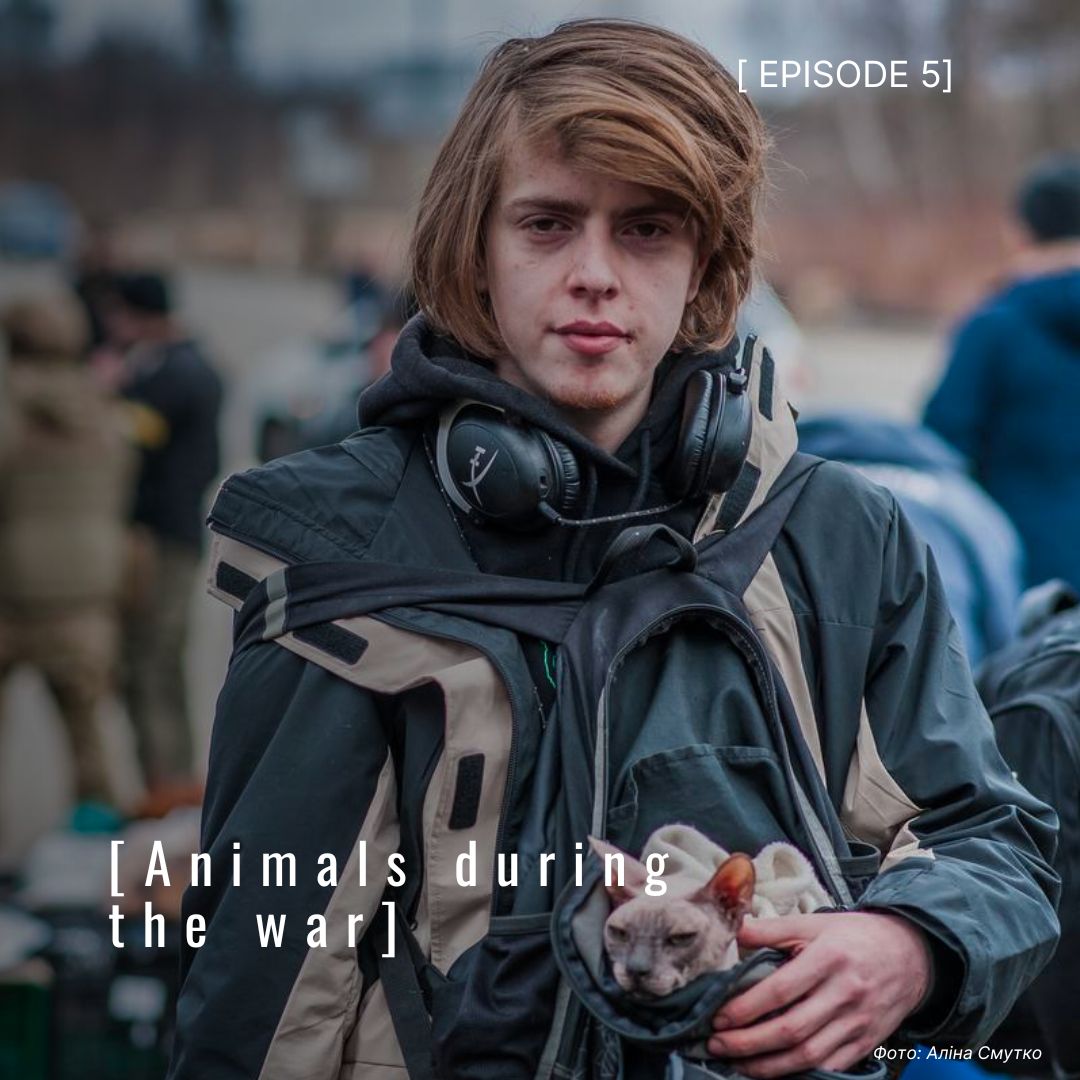
Hello, my name is Liena. I have a cat, a Canadian sphinx, and he’s called Fluff. He has been living with me for 4.5 years.
Some few weeks before the invasion I started reading the articles about the bomb shelters, and everywhere it said that animals not allowed. For me then it was so weird and baffling. How come? Many people have animals, I don’t know the statistics, but among my friends about half have pets. Cats, dogs, other pets. And what these people are supposed to do, sit in the apartment and wait for death? I didn’t understand. I thought, wherever I go — the cat goes with me. Because how else? Where would I put him?
Fluff and I already traveled a lot, moved places, for 2 years we lived in Ivano-Frankivsk. My cat is highly adaptable, sociable, loves people. And overall all my friends who looked after him, he liked all of them. And overall, he likes people who feed him.
*
At the beginning of the full scale invasion, Liena and Fluff lived in Lukianivka neighborhood, right next to “Ukrainian Defense Industry”. So the first days of bombings they have spent in the basement.
*
It’s always hard for me to understand what is bothering him, but I always see when he’s feeling bad, and often it turns into some somatic problems. When the war started I had 2 bags of cat food prepared, enough for about 2 months and the carrier at the ready. I shoved the cat in the carrier. I don’t have any problems with that — he always calmly gets into it by himself. But I also was somewhat stressed on February 24th — shoved him into the carrier and we went together to the basement where we spent 5 days.
5 days we spent with Fluff in the basement, then a month in the house outside the city, we had room there and we spent the entire month there side by side. I joked that we have a toxic codependent relationship. Sometimes he really annoyed me, because there was nowhere to escape from him. But overall he doesn’t get in the way much, he wants contact, wants to purr, sit on me, be near, but at the same time he was never a problematic cat. All the problems that arose I saw something like that: well, I need to find out if he’s sick, or it’s behavioral. To put it plain, not critical. Critical was that he remained an alive, healthy and happy cat.
At the beginning of April I came back to Kyiv, when the region was already deoccupied, and my friends from the Netherlands have been inviting me to visit for a month now: try, and if all is good, you’ll come home.
*
Few days to think, negotiate with a landlord to lower the monthly rent, and Liena decided that Utrecht, a small town near Hague, is currently a better place to live than Kyiv.
*
In the beginning of April I went to the Netherlands with Fluff, a suitcase, backpack and a travel bag, where all of Fluff’s stuff was. It took more than 20 hours to get to Warsaw by train. On the Polish border, Fluff was vaccinated and chipped, right at the train station.
Next morning we went to Berlin from Warsaw, 6 hours. There, I waited for the next train for 3 hours and then 6 more hours to Amsterdam. Over all, the road took 2 days. It was physically exhausting, but I think it was harder for people who left the country with kids or several animals, or older relatives. So it was hard, but it was overall bearable. I, for some reason, vividly remember how I stood on a platform in Berlin, waiting for the train to Amsterdam, it was 20 minutes late. A man came up to me and asked if it was a cat in the carrier. Asked if I had tickets with the assigned seat and asked not to sit near his family because his wife is allergic to cats. And I felt so sad and wanted to cry. I understand that some people are allergic, but it was something like, like he was disgusted at the fact that I took a cat with me. Or maybe, I just saw it like that because I was really tired. I. the end, when I got on the train, I stood there and waited when everyone will board because I needed to find a place to sit, a train attendant found a place for me, but I was asked to leave, and I went through all the carriages with the cat, backpack, suitcase and the bag, through narrow pathways and looked for a place to sit.
*
In Amsterdam, friends picked up Liena and Fluff and drove them to Utrecht, where they lived for 3 months. This time became a real challenge for their relationship.
*
My friends have a house and they gave us an entire room. It was a wonderful room, wonderful conditions, but my cat wasn’t used to his space being so limited and he would literally sit on my head and every night I would wake up, 2-3-4 times and me and my friend who just had a child were jokingly counting who woke up more often at night. At home, I usually don’t sleep with him in the same bed, he sleeps in the kitchen, he has his bed and a rug, food, litter box — all that he needs I have out because he doesn’t sleep at night, wakes up nervous. And so, every night he would sit on my head and bat at my eyes for me to wake up. I was so angry. And then I was just tired.
So in these three months, I didn’t sleep a single night how people are supposed to sleep: falling asleep at night and waking up in the morning. I woke up several times.
*
From what pet owners say: doing some bullshit that makes people furious — is a typical behavior of an animal under stress. Same things Lisa says about her dog Yukka, with which she left Kyiv to go abroad and traveled, probably, throughout half of Europe.
*
About three months we literally fought to stop her from attacking everything that moved. Now, she still has moments when she sits in front of the window and barks at everyone, who passed by. And you pull closed the curtains: please, hope the neighbors won’t tell us off. Before, at home, she never did this. Here she tore the pillows, threw stuff. Could actually take her bowl and throw it in my face. And would look at me like all was fine. This was how stress affected her.
*
Through trial and error, Lisa found out that keeping the routine the dog is used to, helped to correct such behavior. It turns out that not only people are calmed and grounded by rituals.
*
But then I started to settle in, even if we are moving, or on the road. Your walk is always from 8 to 9, so we’ll drive after 9. First you walk, then eat, 30 minutes to rest, and then we can be on the way. And the same thing in the evening, so I kept the time of her usual routines. When she walks, eats, sleeps, I tried to keep the same time and with time she didn’t take the moves as something special. Because she knew, that at this time she’ll go for a walk, sleep, eat and she started to have a better attitude towards it. Not as psyched up as in the beginning.
And even in the normal state when you miss a walk, she won’t understand what she did wrong.
It’s an animal, not a person. You can’t explain to her that she can’t do that, or that we are running late or something. You just need to accept it. And understand that you adjust to your animal, and later you’ll figure stuff out and explain why you are late.
*
Liza is from Crimea, she moved to Kyiv after the peninsula was occupied in 2014. She got Yukka two years ago, it’s a special god with a difficult background.
She’s deaf and she was brought from Turkey. Because she’s a bulldog type what waited for her there was death, they are either put down there, or someone tries to save them, so she was one of the lucky ones, fortunate that a volunteer noticed her and brought to Ukraine.
*
Growing up, I always had animals. And the last ones were my parents’ two dogs, Stuffords. A girl and then a few years later another dog. A reject that no one wanted. We took him in, because he was a handsome boy, nothing wrong. They both lived 15 years with us.
I decided, that I wanted a dog and went to the Sirius shelter with other volunteers to clean and feed dogs. I didn’t go with a goal of immediately adopting a dog, but just to see if I’m ready for a dog, do I understand the responsibility, because there will be no mom and dad that can walk a dog instead of me while I’m busy with work or errands.
I wanted a Pitbull or a Stuffy — the breed that I already have experience with, that I understand. And I understand that they have fewer chances, because everyone likes adopting smaller dogs, preferably puppies, that don’t look in any way even marginally dangerous.
So I started to ask a person who organized these volunteer trips if he knows of any Pitbulls or Stuffords that are looking for a home, because I had experience with the breed and know how to work with it. He said that he knows one, but there is a caveat: the dog is very pretty, nice and fun, but she is deaf.
And because we had that second dog, somewhere around 12 years old he went deaf, didn’t hear much, but we got used to communicating with him. When we teach dogs commands, we also teach a gesture or a sound, besides the voice command, to signal how this action should look. I thought why not and started visiting the shelter. I walked the dog, bought her leashes and stuff that would work for her. I wanted to understand if I could handle that dog. If we could communicate. And I kinda understood that it was working out. It so happened that from the first time the dog was so gentle with me, so agreeable. Despite her not hearing anything when we walked, she’d always turn around to check. So after around two weeks, I started to let her off the leash. There was a place to walk, a big forest where I could find a quiet place to let her off the leash and see how she would react. I saw that she didn’t go far, 5-10 meters and always came back.
The dog got used to me coming to the shelter and if I would walk past her, to wash my hands or something, she would bark. Bark as mad — and I understood that the dog also loves me and it’s time to take her home.
*
Now Lisa and Yukka are true friends and equal partners. When it came to leaving home, the question whether or no to take Yukka with her didn’t even arise.
*
Either we are leaving with the dog or no one is going anywhere. Because how could I? Firstly, even if she wasn’t deaf, I still wouldn’t leave her. I made my decision consciously, yes, maybe it wasn’t the best time and maybe if I knew that the war would come I’d wait with getting a dog. But what happened, happened. Secondly, to abandon a deaf dog that already went through great suffering and questionable moments with people. As far as I understand, in Turkey she was used as a puppy-making machine to use them in fights. What are you saying, how to abandon her?
She’s like my little baby, a bit silly, but she’s mine. Nothing to be done about it.
*
Because it’s difficult for Yukka to be around strangers, Lisa couldn’t go to bomb shelters with her. And later, she made a decision to buy a car in Europe.
*
She’s slightly aggressive towards people, it’s a drawback, because I can’t explain to her with words that no, you can’t do that, I can only explain with gestures.
And she looks so cute, nuzzles up to everyone. But as soon as you reach for her, she is not so cute anymore. And this also creates problems when you are on the walk and she comes up to other dogs. A person reaches to pet her and it’s instant aggression. And you in different countries in different languages try to explain that it’s not because she’s aggressive, but scared, that’s why she attacks.
Same in the bomb shelters, we couldn’t stay there because there were lots of people, kids, running around. And I put her muzzle on, but it didn’t help because I saw that she wasn’t sleeping. She wouldn’t sleep for 24 hours or more, because she was constantly on the lookout of what’s happening around. So we just stayed at home. And then I made a decision that we can’t go to bomb shelters.
Additionally, not everyone understood it. Like, you have a dangerous dog, why are you taking it with you, leave it at home. And in my understanding, I’d rather stay at home myself than leave her. And so we decided to leave for Poland.
*
In the last half year of constant moving, Lisa became an expert in “What European countries are most and least pet-friendly”, and also a guru of documents, vaccinations and rules for entering each country with a pet.
*
Of course, it sucks when you run around, as if set on fire, the day before because you were told that you need some certificate to travel with the dog even if it has a European passport. Many people in Europe don’t even know how it works: “You have a European passport, but we don’t know if you need that certificate. But you better have it, just in case”. It took 5 days to get it. And you postpone the trip because of it, but it turns out it wasn’t needed.
They looked at all the documents, asked questions. I had two dog passports — Ukrainian with all the vaccines that can’t be remade. Another — European. And I confused them, why do I have two passports, why not one, why there were fewer vaccines in European one compared to Ukrainian. Constantly, I had to explain that here is a full list, but at some point we got a European passport and all new information will be in it. Somehow we managed.
So before every non-Schengen country, or a Schengen candidate country, we had to go to the vet. And they would give us a certificate, for example when we left Montenegro for Croatia and yadda yadda. When we were going from Bulgaria to Serbia we were asked: “Why did you take a dog with you? What for?” And you look at them like it’s supposed to bother you. “Why not a kid?”. Something like that. And you are like. I don’t know how to tell you: I just don’t have kids, but do have a dog. Something like that.
We reached Montenegro, settled in the town called Bar. It’s basically on the coast of the Adriatic Sea. It was a little better there. Every day we would walk by the sea. For the dog it was okay. For me — at that point, I didn’t care. But there was a dire situation with animals, I think even a bit worse than in Ukraine. Even as pets, they lived in horrible conditions. We rented a place and across from it was a house with a dog. And I’d go and feed that dog, because firstly it was huge, needed a lot to eat. The dog was around 50 kilos. At least it supposed to be. It looked about 15 kilos — so skinny it was. And for 3 months, I would go feed that suffering dog and my dog.
It was almost impossible to get pet food there. I bought it in Bulgaria, several bags, because I was told that the situation with it in Montenegro is difficult, it needs to be imported from Serbia or somewhere else and you won’t find the food your dog eats.
We stayed in Croatia, Slovenia, Austria and Czech Republic. In Croatia, we stayed only for 5 days. After Montenegro, it feels so civilized and free. You can do everything with a dog, go everywhere, even into some shops. It’s really cool and I want it to be the same way in Ukraine.
*
A particular negative experience of Ukrainians abroad is inevitable contact with russophiles in European countries. Bulgaria and Serbia left the biggest impression on Lisa.
*
In Berlin there were lots of Russians that somehow got there and every time I came across one was unpleasant.
In Montenegro, we also came across some Russians. Well, our car has a Ukrainian number plate. And some guy was walking behind, thankfully the dog was in the backseat. He wanted to come up and shatter the glass, but she snapped and he just went on his way.
When we were going to Montenegro, we went through Serbia and stayed there 3-4 days. And there we came across them almost on every step. Wherever we went, we were asked where we were from, and we would answer that we are from Ukraine. And then came constant: u have a stupid war; u have a stupid government; u don’t understand, Russia is gud. Something along those lines, and you sit and listen to it and think: you have already left, you don’t want to hear that Russia is gud and all else. You didn’t ask people about it, at all. Their opinion. They asked where you’re from, you answered, that’s all. I didn’t need further comments. And in Serbia it was brutal. We spent all days indoors, only going out to walk the dog. Just wanted to leave to someplace else, because wherever you went, everyone told you that you were doing something wrong.
Came to Bulgaria and spent 3 months there. But decided that we needed to leave. Because it’s a very interesting country. Firstly, many russophiles, who are for some unknown reason, they have a deep respect for Russians, who saved them from something. To this day I don’t understand from what. But something like that.
We had the situation when someone damaged our car slightly. And then someone complained and it was towed away, and for several days police didn’t tell us anything. Well, they said it was stolen and wasn’t at an impound. We just drove around every impound, hoping it was there. Because the car is old, who would have stolen it.
You are kinda safe but also not. If there are any russkies there will be conflict. But also if the country generally holds some kind of neutrality, then it’s very, very hard.
*
Finally, after driving through half of Europe, Liza and Yukka again settled in Poland. In her, already educated, opinion — currently it’s the safest country for Ukrainians. Current plan is to stay until December and then come back home.
*
Here you can feel safe. There is no talk of Russia, or only negative one. You understand that you are surrounded by like-minded people. When we entered the country, there was lost of help. Help was everywhere, helped to get on the train, a person who drove us in their car gave some cash, zloty, just in case if something didn’t work out with a place to stay, there was enough to book something.
Lots of Ukrainian language content — in supermarkets everywhere are Ukrainian-Polish phrasebooks. It’s better in Poland than probably in any other European country. And finally we managed to find a place in Poland. Currently, we are here till December 6th. So, 3 months rent agreement with no extension. But we thought that this is it. It’s our final move, next one — only to Ukraine. Because I can’t go on. Because you can’t feel nothing everywhere. You have no objective rights. If you don’t like something you just have to bear it, because, again, you are in no position to say I want, I can. Yes, even if you pay for everything, you still need to keep your cool.
Currently, the situation is, you don’t want to paint Ukrainians as some savages that will fight tooth and nail for everything to be how they want. Not the time for that. Plus, we didn’t come for a vacation. We just try to live somehow.
*
The same thoughts were on Liena’s mind when she and Fluff left the Netherlands and came back home. And in Kyiv she did what Olena described at the beginning. Liena wanted a dog for a really long time, but kept postponing the decision. War, uncertainty and closeness of death made everything easier: less thinking — more action. That’s how she got puppy Emma, she’s 4 months old.
*
When the war began, I realized that my dream of getting a dog may never come true, because I had a condition for myself that I’ll get a dog when I’ll have my own house or flat. But at the beginning of the war I realized that I may never have a flat, but I want a dog and life is really short.
I promised myself that as soon as I get back to Kyiv and the situation stabilizes, I’ll start looking for a puppy. I thought that it must be a puppy, because I wanted it to be friends with the cat, and when I come back to Kyiv I’ll immediately start looking for another flat which will allow me to get a dog. I found a flat and in a few weeks I went to Sirius shelter and chose a puppy. I called her Emma, and Emma has been living with me for a month and a half.
Emma is a mixed breed. It’s a hunting one. She has lots of energy, I just don’t know where to put that energy. We walk three times a day, constantly play and exercise. First three weeks were very difficult, then friends started to offer to babysit her and it helped. Puppy is not a cat, it demands your constant attention. When it’s not asleep, it always wants something from you. But I think it’s worth it. Sometimes I wake up in the morning and think, “damn, I have a dog” — and it’s a completely new feeling.
*
Liena is a person of strategic planning, she feels more calm when she has a concrete plan of action for different outcomes. Now, her main concern is how realistic is the scenario of a second Russian advance on Kyiv and whether she’ll have to leave again. Because now it’ll be way harder because she has Emma now.
*
I have no special plans — parent her, teach and watch her turn into a cool adult dog. And in case I’ll be like in March or worse, or something different, but if we’ll have to run away again, so be it: the cat has a carrier, the dog has a leash — we’ll go wherever we need to go.
I don’t have a car, and I realized that it’s a big drawback. It’s an asset you really need. Before, I thought that you need a flat and the car can wait. But simultaneously, I realized that if people are ready to help you, they are ready to help you with the pet. So a cat + dog don’t really change how people treat you. And good people helped and will be helping.
The only thing that I’m scared of this winter is that it’ll be cold and animals can get sick. I’m especially worried about my cat, he’s hairless and already cold all the time. For the dogs because she’s young. Honestly, with the dog I got many worries about her. Worries that I have never encountered before. But at the same time I have met many cool people, because I socialize in some way with other dog owners, checkout workers, waiters, taxi drivers and when you start to talk more you realize that there are some wonderful people, they tell you about their pets and take care of your dog.
We were taking a taxi recently and the driver asked if the dog feels nauseous and if he should slow down. I said that he shouldn’t worry, she won’t throw up, she’s asleep. And he said that he worries not about the cleanliness, but about the dog feeling okay. And then he talked at length about his dog that passed away a long time ago.
So I don’t have a fear that we won’t get to safety. If the need comes to save myself, I’ll also save my pets. And if I’ll be able to save myself, I’ll also be able to save my pets.
*
A somewhat separate from the rest but not less important topic is abandoned and stray animals on the front lines. There is a Twitter account UkrARMY cats&dogs, where the authors every day post new photos of military personnel with cats and dogs who have no owners, that they feed near their positions. Besides it, there are dozens of other communities on the topic, posts and even accidental photos from soldiers, volunteers and media people. Even from this limited information, we can understand the catastrophic scale of animal homelessness on the contract line.
Recently I stumbled on the Twitter thread from Dmytro, fighter of Svoboda (Freedom) battalion, call sign Glazun. It was about this very topic. I decided to inquire more about it.
*
There are many animals at war, mostly cats and dogs. Generally, dogs are a good indicator of where people live. It was always like that because they stick to people. See us as the source of survival, food, most probably. It’s easy to find the position by observing where dogs go — look closely, and you’ll find positions, either friendly or enemy.
Mostly it’s dogs and cats, some other pets sometimes, that get abandoned, but I didn’t see much of it. A great number of dogs, wherever you go, after half an hour to an hour — you see them, one, two, three. They are hungry, need care, tick medicine, fleas treatment.
Mostly no one takes care of it, obviously, someone can show initiative, ask to send a flea collar or medicine. I did it several times, but it’s hard to control it — too many of them, on every position.
Why it happens? Well, it’s a war, and people probably act, just leave these animals, don’t have opportunity to take animals with them. And it’s truly horrible. I don’t know how you can leave… those you’ve tamed, and a part of yourself — it must be really painful. I hope at least that it was painful for those people, because otherwise it makes me sad for our society.
*
One thing to note about Dmytro, is that Donetsk region is his homeland, he’s from Yenakiievo. Before the full scale invasion he, as he put it, “was living his best life”, traveled a lot — he has more than 50 countries under his belt — and grew his business, a chain of hostels on Cyprus. Since spring, he was on the front lines and fought, notably, for Sievierodonetsk. So everything he’s talking about he saw first hand.
At home, Dmytro also has a dog from the street, or, more accurately, from the Carpathian Mountains. The story of their meeting is beautiful and soulful.
*
I have a dog, her name is Couscous, it’s a girl, she’s two years old. We picked her up in the forest, or she picked us out — it’s not clear. In the Carpathians we were going to the camp, made a stop near Tarakaniv Fort, were standing in the gazebo there, eating a melon. And sometimes started to move from under the fence, small, furry, covered burdock and ticks. We held it for a bit, then let her go, and next she just followed us to our car, some kilometer and a half and we decided that we’ll give her a chance and take her with us into the mountains. If she goes with us for a week-long mountain hike, then we’ll take her with us and then think about what to do. And she went, with her tiny paws stomped into the mountains. And so she stayed with us. It was the best decision of the last years — to get a pet, it helps to live, to find joy in life, to walk, it gives a portion of oxytocin. And it simply makes it easier to find joy in life.
*
He says that it’s because of this feeling of joy and involvement that fighters on the front lines quite often take care of abandoned animals.
*
This connection gives the feeling of serenity, connection and safety. And probably most important of the enumerated — connection. You go through this tough period with someone else and it’s actually much easier. Simply easier and better. And it goes both ways: a person finds an animal that they can look after and in exchange gives the feeling that you aren’t alone and there is hope.
*
Although the real second chance for a new life — when the new owner takes the animal to a new position or home — very few animals actually get.
*
Yes, unfortunately, in my experience, about 20-30 percent of animals get lucky, get so close with someone that they become inseparable. And they move together. Often it’s medium-sized dogs, or small ones, there is no place for big dogs, alas. There are different situations, sometimes a dog is just… For example, Sievierodonetsk we had a big dog, it was just scared, afraid to come out and it was impossible to drag her with you, she stubbornly didn’t want to go. And no one had time to deal with that, because the first priority is to save your life and move the combat system. There are different situations, and more often dogs just stay. If they don’t follow people, they have little chance to survive — no one is going to additionally carry the dog on their back.
*
I ask Dmytro to tell a kind story with a happy ending.
*
We had a small dachshund Bullet, one of the commanders “Sharhorod” took her home. Small dachshund that stuck with us since the first days in Sievierodonetsk. She’s a real battle dog and would always walk next to “Sharhorod”, they became real friends, she even went to reconnaissance with him, and after all he took her with him. I even took her from Sievierodonetsk. We were the last to leave the position, in an old car, I was on the front seat holding her. She’d look out the window, looking at something in the complete darkness, without car lights, any light source. The driver had night vision goggles on his helmet, but the night was quite bright. In part from the smoldering city, you could see the remnants of the Mordor it was turned into. 80-90 percent of the city was destroyed. We drove, the dog looked out of the window, I held her on my lap. And Sharhorod took her with him. And even in Zaitseve when we were there, and after the rotation he took her home. And then she again went to the front lines with him and stuck by his side.
*
Animals save fighters from despair not only during the war, but after too. Because it sometimes happens that adapting to civilian life at home is as hard as surviving in the fight. Dmytro brings up the example of friendship between Masi Nayyem, Ukrainian lawyer and military man, and his dog Barmalei, who stuck by the position of fighters near Toretsk and who Masi later took home.
*
Masi told somewhere that Barmalei, his dog, helped him to get through the difficult times and how much easier it was with him to adapt to civilian life. And it works like that with all dogs. In States, veterans with PTSD and trauma are prescribed getting a dog, to make life easier. It works basically even on the level that dog makes you move. And when you move, you produce hormones that keep you from falling into the pit of depression. Plus, when you touch the dog, any other live creature, you get a good portion of oxytocin that’s responsible for joy and happiness in your life. Dogs are good for your mental as well as physical health, because they make you move and be happy.
Because animals, especially dogs, are genuine in their emotions. No one will love you as truly as a dog. Be happy to see you, wait for you, show real emotions — just how they are, not expecting anything in return.
*
This episode was about stories of mutual love and devotion of people and animals. About experience of running from under fire and occupation, moving abroad, shelters and adoption. But also about less fortunate — abandoned animals on the contact line. Finally, I want to add an obvious: if you made the decision to get a pet, get it from the shelter or off the streets and do it consciously and carefully, with sober evaluation of your resources, finances and love of surprises. Because an animal isn’t a decoration or a charity case, and won’t necessarily fulfill any of your expectations. Best case scenario, it’s your partner till the end of its life.