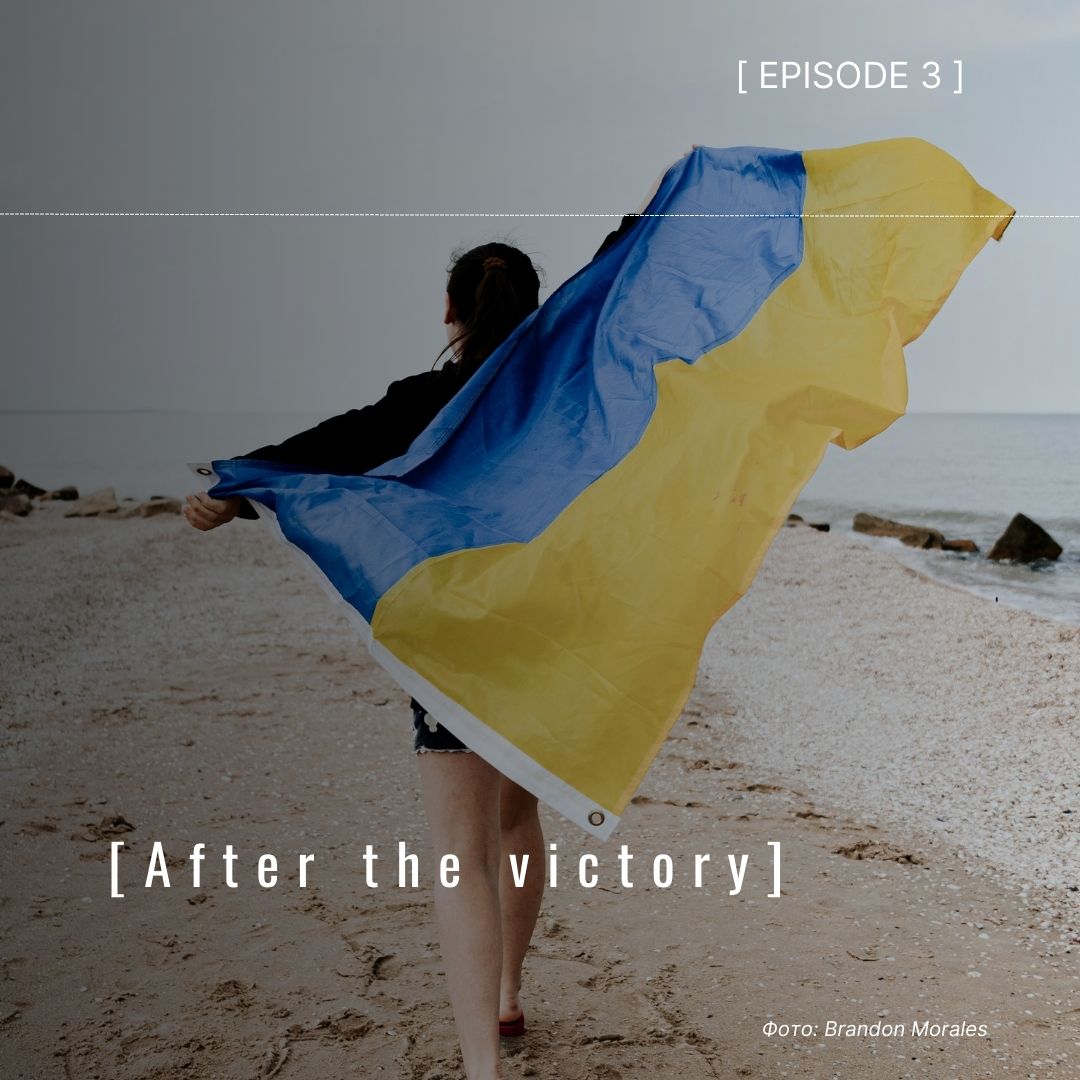
Episode 3. After the victory
A week without news and social networks, having lunch with friends, going to the ocean, or having a dog – what are the dreams and plans for life after sirens, bombings, and shelling? Why do some thoughts add strength daily while others bring pain or irritation? And how to support your loved ones at a time when even tomorrow is unknown, far away?
Епізод на інших платформах:
Текстова версія:
A few days ago I stumbled upon a tweet from Taras Chmut, director of “Come Back Alive” foundation, where he asked about the plans for after the war. As one would expect there were a lot of bravado-filled answers, about summer in Crimea or Luhansk, and Russia, that no longer exists. And simultaneously, there were lots of heartfelt, very personal and bittersweet things that make you feel a little brighter and lighter. “I’ll go and sit on the park bench at 2am”, and immediately a reply: “You can expect me sitting right across from you”.
I want to finally buy my own place and have a child, we’ll drive around night Lviv with my wife, and eat ice-cream cones at McDrive. I would like to look after an orchard or a vineyard, as my grandpa did. If I get to visit liberated Luhansk, I would do it at his house. I will hug a lot. I want a cottage up in the mountains, make cheese there, keep animals, get up at dawn and read a lot. I’ll finally have a good cry, and after that — live my life.
Third episode, we decided to dedicate to something good and helpful. Plans and dreams for the future that help to remain afloat today. And along with it, talk about why many of us have no such plans whatsoever. And how to survive the state when even tomorrow is something far-off and obscure.
My name is Alyona Savchuk and this is Blood and mud podcast.
*
Hi, this is Marharyta Tulup and I thought for a really long time what special thing I’m going to do, when I learn that Ukraine has won. It won’t be something special according to people who never knew what the war is and never lived in the country going through war. I simply understand that the very same day we win, my old everyday life will return. And it’ll be a life without fear, it’ll be a life where I can do my usual things and not feel guilty about it or feel afraid and constantly feel in danger.
I just want to wake up on Saturday morning, make myself a cup of coffee at home, go to my workout, then buy myself a croissant and sit at the waterfront, in Rusanivka, and simply know that it’s just another Saturday when I don’t have to hurry.
*
Hello. My name is Lena, I’m from Kyiv and I already told you about what I did on the first day of the war.
After we left the basement, I lived at my boss’ place for a month, then I spent five more days in my apartment in Lukianivka, and now I moved to my friends in the Netherlands. So the first thing I’ll do after the victory — is come back home.
I truly hope that I can come back home, if in the foreseeable future, in the next few months there will be no threat of air strikes and no active warfare in Kyiv.
*
This is Alina. Somewhere on the 10th day of it all, I started to make little lists of what I’m going to do when… after we win. As people say, not when the war will end, but after our victory. And I wrote extremely simple stuff. And every list had a McDonald’s cheeseburger, when it’ll open up again, yeah. I don’t even know a coat hanger from IKEA, this kinda thing.
But I started noticing, firstly, that the horizon line moved so far away that you can’t even understand where this benchmark of victory will lay. Because in the first days it all seemed simple. We’ll just wake up and say: “Russia is dead and gone”. But now it all drifted and shifted so much that you, like, feel okay in Kyiv, further east not so much, but maybe in, let’s say, Chernihiv you’ll feel like in Kyiv some time from now. It’s a very uneven feeling.
*
Actually, the way safety is relative is a curious thing. Some people have never left their shelled cities, some have stayed more or less consciously to outlast the occupation, others have left to go abroad as early as February 24th. There is no universal scale according to which people made one or the other decision. This isn’t a question of self-preservation or self-sacrifice, bravery or cowardice, it’s just that everyone’s brain works differently, reacts to different things in different ways. The same way that for some, plans and dreams are one of the whales on which their psyche and reasonable everyday life rests. And for others, like, for example, the mother of my friend from Chernihiv, that has spent several weeks under heavy shelling — it’s a sensitive question that makes her sob violently. Or a completely opposite reaction from my acquaintance, who’s actively helping in the de-occupied villages. This question enrages him, like a red rag to a bull.
We talked about the reasons behind such polarizing emotional reaction, with a therapist, Tara Konrad. Tara’s main area of expertise is trauma therapy. She has more than 10 years of experience working with trauma of war, currently she’s helping Ukrainian warriors and people who fled the active war zones to navigate current reality.
*
The thing is that the events that started on February 24th, we call them a new phase of war that has been going on for 9 years, active phase. But for many people it came as shock, it was a state of shock trauma, and this state still continues.
There are commonly accepted, scientific criteria in psychology that determine what event is considered shocking, and these criteria hold answers to the questions you’ve asked. Firstly, it’s how sudden the event is. Second criterion — complete loss of control over the situation. Third one — the fact or a threat of deaths of a person themselves or a great number of people. Forth fact — serious injuries or sexual violence. Fifth, a feeling of dread and helplessness. And sixth — formations of dependency on other people. What does it mean? It means I can’t leave by myself, I can’t go there because something was destroyed, can’t get out and get help.
This in particular, we don’t know how people will react to it, because it’s not possible for everyone to have the same reaction. Reaction depends on the experience, depends on — there is a term in physiology — attachment, on the foundation, current physical state, your education, type of nervous system. All this combined gives us a great number of different reactions.
Secondly, look, how sudden it is, the complete loss of control over the situation, in our mind, in the state of shock, it totally shatters the timeline. Completely. And when the mind recovers from the state of shock, it leads to reconstruction of the timeline. It also happens in different ways, it depends on if the person is in a safe state, situation and place, how many people are around to support them, how much in their life depends on others, and how the person’s body has reacted.
*
Tara often references her previous practice and compares the beginning of the war 8 years ago and how it’s now.
I have experience, and it began not in ’22, but in ’14, when we worked with people who fled from the fire in Donetsk oblast, for them the step on the timeline was 5 minutes. Meaning, I understand what I’m going to do in the next 5 minutes. My girls, I myself, haven’t encountered this yet, but my girls that work with people who fled Mariupol say that it happens. Or a step of 10 minutes, or an hour. Such a timeline.
Now I organize and work with support groups, so we agreed that we operate with a 12-hour timeline. That for 12 hours we can plan and understand what is what. And when we begin to go back and return to our normal state, and leave the traumatic shock event and put our nervous system back in shape, for us the timeline gets longer.
The horizon of planning gets bigger. It’s the first thing. The second one is that in a traumatic event, “tomorrow” isn’t the only thing that disappears. Together with “tomorrow” the answer to the question “Who am I?” completely crumbles. I know who I was before this situation, but when I lost all control over my life, when my life depends on how much and in what way others will help me, I lose this “Who am I?”. Second, we lose our roles. I was a person who did this, that and the other. And now these roles are shattered. Social networks are ruined. I had friends, neighbors, and colleagues. Everything is destroyed, we are all in different places, and it’s really hard to keep in contact. The new networks are created, but we can’t truly count on them. Why? Because we don’t know them well enough and can’t trust them yet.
Our worldview turned completely upside down. We can’t give answers to the most important questions. And no one can say when it’ll end. What will the world look like? What will Ukraine be like? When will mines be cleared up from the fields, and small villages and towns that were occupied? These moments, these facts are very important for our brain, like, you know, when the fence is built first you put down posts. I understand this — put a post down, also this — another post, and that — one more post. But we don’t have these posts, and there is no one in the world who can answer these questions.
And to keep your psyche from melting down even more, we put the posts only when we know something for sure. I know that I’ll finish talking with you, and given there is no airstrike, finish the interview and go to work. If everything will be good, I’ll continue to work, and I have another meeting, and one more often that.
*
And here Tara brings up an interesting observation from the experience of her colleagues from Israel. In Arab and Muslim countries there is an expression, or more precisely a prayer, “In sha’Allah” that can be roughly translated to “if God wills”. It’s used when talking about the desired future events, meaning that the person has plans and hopes for the future. But the responsibility for what happens and what doesn’t, the person shares with Him, who is above. And if the plans don’t happen as desired, that means that He knows better. To understand yourself or a close one in this state when you don’t know for sure who you are and where you are going, it’s probably just a half, or maybe one third, of the work. But you have to navigate out of this state and don’t make it worse.
*
You know, it’s best not to say “It’s all gonna be alright” ever. We don’t know anything. It’s best to work with what we can lean on here and now. In a literal sense, what works the best is a real simple practice, but it’s effective, because it brings us back to the here and now. You should stand firmly on your soles, and everyone knows how to draw a one, right? Short line is an inhale and long one is an exhale. And doing 5-7 inhale-exhales like that helps to come back, stop this wave of “it’s all over”. We come back to ourselves and start to look around.
Next technique, also really simple, it’s all over the internet now, you know name 5 green things, or red ones, what smells do you feel, what sounds you hear, what do you feel in your body — it’s a grounding technique. And when you are grounded, you can ask: “What can I do right now?”. And ask this yourself every 3 hours. What am I going to do now? If you can do it, then broaden it to 6 hours. And to 12. Or a whole day. And check if you can keep it up and not feel helpless.
*
Tara says that we can draw a parallel between what we are going through now and the concept of the VUCA-world in business. Every letter stands for a certain aspect: Volatility, Uncertainty, Complexity and Ambiguity.
*
This is the VUCA-world that businessmen have been talking about 10-15 years prior. And it’s unavoidable. And they found out that in this VUCA-world there is only one unchanging point that we can lean on. It may sound absurd now, but this point is a constant change. And when we lean on the point of the constant change, we don’t get the certainty that everything will happen as we want. I want this to happen. If it doesn’t, then it’ll be something else. And it gives a very small but really sturdy foundation for our psyche.
*
I thought long and hard about plans for after the victory. But I realized that the line that we’ll call victory for me won’t be definitive. For me, it’ll be blurred, because I won’t be able to see a bright and complete victory in it. We, as humankind, already lose because we fight in wars. And this war, as every other one, won’t have winners. So the plans stay the same as always, just live, just work, better myself, participate in social projects where I can help others.
Also, this war helped us to clearly understand one more thing — that these timeframes, like “starting Monday”, “after Easter” or “after the victory” don’t work. Because if we don’t do something right now, don’t start something, then we also won’t do it after some date. So now is the best time to start what you have been planning. I think there will be no better time.
Of course, the war limits what we can do, so among the small plans that are easier to accomplish after the war, is to see all my friends, including those who are now on the front lines, in the army. I want them all to come back safe and sound and, after the war is over, we will all meet and talk. The dreams are as grandiose as they were. I, as before, want, truly, truly want to live in a society where human life holds a supreme value, not on paper, but in reality. And in such a society, a priori, wars cannot exist.
*
You know, Alona, it really scares me when people say “That’s all”. What “that’s all”? Where is that “all”? There is a scope for bad things. In my life, in the world. Listen, look and listen to our compatriots who have moved to many different countries. What do I hear now? That it’s bad there, and it was better in Ukraine. That we have better cell coverage, bank system, better transportation, tastier food. So not all is lost. And this “all” becomes an elephant you need to eat. You cannot eat a whole elephant, but if you cut it up into small pieces you can do it. Turn this “all” into concrete criteria. And then looking at these criteria you can see what you can change, what you need help with, and accept that some things you can’t change. And then the world stops falling apart, no more “That’s all”. So it’s about your physical and mental responsibility, what can I do? Well, at least don’t say that “that’s all”. I think it’ll help us to survive and do our job. People tell me: “That’s all, Ukraine is gone”. Take a map, open it, and look, what it looked like on February 24th and what it looks like now. How many regions were liberated, reunited with Ukraine. Every day we hear that our guys and girls liberated our land, 3 kilometers there, 30 here, somewhere 40. Yes, of course we want it to be instant, like Okudzhava sung “I woke up in the morning and there were no fools, they all flew away”. I also want that. But it isn’t possible. But we can do it step by step.
*
Tara suggests that everyone defines for themselves what will mean the end of the war for them. She says that she asks people about their criteria every chance she gets. Here are the most typical answers.
*
First stage — when there will be no airstrikes on all Ukrainian territory and the battles will be only for liberating our territory. Second one — when we are liberated and back to the national border as of January 1st, 2013. When we return Crimea, Donetsk and Luhansk, all our territory. Third stage — when our army will enter Moscow. Fourth — when our neighbor gives up its nuclear arsenal. Some say there is a fifth stage, I understand and agree — it’s when the empire falls and new countries will be formed, that will be aligned with religion, people and cultural traditions, and won’t be a part of an empire. And this is how we’ll end this war. What’s next? This is. I have this question, what are the criteria that we definitely didn’t lose this war. When the Kyiv oblast is liberated. Okay, it has already happened. Next, what we have? Sumy, Chernihiv, Kharkiv regions and, the closest to my heart, south of Ukraine, I wait for the moment when the towns and villages of Kherson and Zaporizhia oblast will be free. These are the steps towards. No, not even towards. These are small steps, small victories that will make up a big one.
*
The first thing I’m going to do when I’m home — I’ll go to IKEA or another pretty store and buy jars and containers for grains, flour, coffee and tea, because when I left my flat in the first days of the war I took all the produce outside. They all were in pretty jars, and my neighbors took them all. So I need to buy new ones. I’ll buy a new houseplant, because my only calathea died, and I had to throw it out. I won’t get another calathea, they are way too capricious. And I’ll get a dog. Actually, I’ve wanted a dog for a really long time, and I have lived with a very cool dog for a month. I have a cat, so I have requirements to a dog. It has to be a puppy, any breed, but a puppy, so it’ll be easier for my cat to get used to it. I don’t think it’ll be hard. It won’t be hard to find a puppy after the war.
Then I want to meet all my friends, everyone who will return to Ukraine. I’ll visit my friend in Irpin, she’s going to return to her flat. I really want to visit Kharkiv in the summer, because I only visited Kharkiv in the winter. I want to visit my friends in Frankivsk so much, and, of course, go to the Carpathian Mountains, and I want to visit Odesa. And I really need to buy a car. I’ve wanted a car for 10 years now, but talked myself out of it, because in the beginning it wasn’t the right time. Then there were so much traffic in Kyiv. But now I want to get a car and freshen up my driving skill. Because if I’ll have a dog, and I want to travel Ukraine, then it’ll be way easier to travel by car with a cat and a dog.
*
And another important thing that I’ll do — I’ll surely go back to Chernihiv to my family and friends, and I’ll just hug them all. It’s probably the most important thing. And my mom said that she’ll buy herself a bike after the war is over, because she really dreamt about, as it turns out, and because she wants to bike to work.
*
From what big things I have planned, one I can already do now — it’s take driving lessons again. And preferably really extreme ones, so I can, I don’t know, drive through swamps in an SUV. And as for small ones. Every small thing that I have been putting off I’m starting to do little by little, because somewhat normal life is starting to return in some places.
Probably, for me the signifier that things are more or less okay will be the fact that I’ll live in my home again on a regular basis, and not in raids as if I were a Mongol yoke. I come, clean up, pack things up and leave again. I’ll live there again, as before, with my kid, and I’ll take him to the kindergarten here in Kyiv, and we’ll go to the kindergarten on the tram, different one each time. Because where we live there are two tram lines, today he likes to take the usual red one, and tomorrow the blue express one. It’s my biggest, greatest plan — live my usual life with my usual company.
*
If you have the energy and opportunity to live here and now, without putting things off for some other day and other place, then it’s truly wonderful. And you don’t have to eat up yourself or your neighbor that dared to look up. For many it’s helpful to start with really basic things, a coat hanger from IKEA, a new frying pan from Rozetka, getting your nails done.
*
You know, I have a question, tell me, if I’ll have a cup of coffee with my friend or acquaintance, and we come up with something that we can do that would help refugees or our guys and girls on the front lines, then what’s so bad about it? And, please, tell me if I go without getting my nails done, how will it help our military? This is absurd. It’s impossible to live if you think like that. Our guys and girls are now fighting, so we can live. And what will they fight for if we here will die? Or, excuse my language, will go to pot so much that we are unrecognizable? (See, this is about the absurd. About the life) When I feel good, I’m more productive. And it’s true for almost every one.
*
Good afternoon. My name is Hosha Meliukhnov. And the first thing I’m going to do after the victory — is immediately go to Kyiv, to my brother, his wife, family, and I’ll finally meet with them. Finally, hug them, will cry for a really long time from happiness and spend all the time with them probably for foreseeable future. Maybe even move to Kyiv, well, I don’t know how it’ll turn out.
We’ll go on walks everywhere where we haven’t yet been in Kyiv, and I’ll talk with them about all kinds of stuff. About what we haven’t talked about before, we’ll chat all the time. I miss them so much. Now, they are probably the only close people I have left. My only family. And also I’ll probably organize a barbecue with my neighbors, with whom I’m hiding together, hid together in the basement. And we will be celebrating, finally having fun, and probably drink and chat, talk about stuff. And especially with my one neighbor-friend, who I’ve met — Viktoriia Ivanivna. She told me about her grandfather who wrote a book, but never published it. And it intrigued me, and I really would like for it to work out. It’s a fascinating story about his life in different regions of Ukraine, and it would be cool if it got published.
I know there will be a lot of wartime literature after this, about war and all that, but this book is also needed I think, it’ll be interesting.
I, of course, am a fan of stand-up comedy, and, damn, I’ll go all stand-ups I can find. Because I… I’ll go to every open mike night, I’ll fail, tell shitty, bad jokes there, something won’t go as planned, but I’ll have a ball, and it’ll be, it’ll be my peace of mind. I’ll go to shows of my friends and online pals, who I talked to online, who I bothered with fire emojis and reactions to their stories. And with their help I kept my spirits high, so to say. I didn’t go completely nuts from all that’s happening. And I’ll buy them books. I like gifting books. And I’ll give them all books based on their interests. Something like that.
And, I don’t know. For me, it’s kinda very important to see, or at least talk with my ex-wife, who I broke up with some time ago, because of my stupidity, to put it mildly, and because I turned out to be a bad person. But I would like to say a few words to her and her daughter, if I can, of course. Something like that.
As for what I want to do in the near future and… damn, I want to sing something in karaoke. I know what song it’ll be. It will be Raisa Kyrychenko song “I’m your cossack girl”. And I’ll sing it so loud, and have a ball, and it’ll be just amazing, because it’ll be the victory, and the end of the war, and I’ll be happy, I hope. I won’t think about death.
I often thought about death before the war, and stuff like that. About suicide and other such dumb things. And I hope that there’ll be less of these thoughts. And I, I’ll just live. Something like that.
*
The key thing from the episode that I would like to reiterate for all of us: having plans and dreams about small things and grand ones, even in the darkest of times — is a great thing. Not having energy and hope for this — is also okay. Drinking coffee with milk, buying a new t-shirt or getting a haircut — isn’t a cardinal sin. It won’t do any bad to people on the front lines or in Mariupol, or Kherson. And it also won’t do any good if you’ll keep beating up yourself, or your fellow humans. The next most important thing is pull yourself together and do your share of work that’s helping our country and fellow Ukrainians to push back against our delusional neighbor.
In the next episode, we’ll talk about war and children. I don’t have kids of my own, but a few close friends do. And observing them for a third month now, I understand that it is an unfathomable responsibility and a difficult task: to try and protect your children from the war.