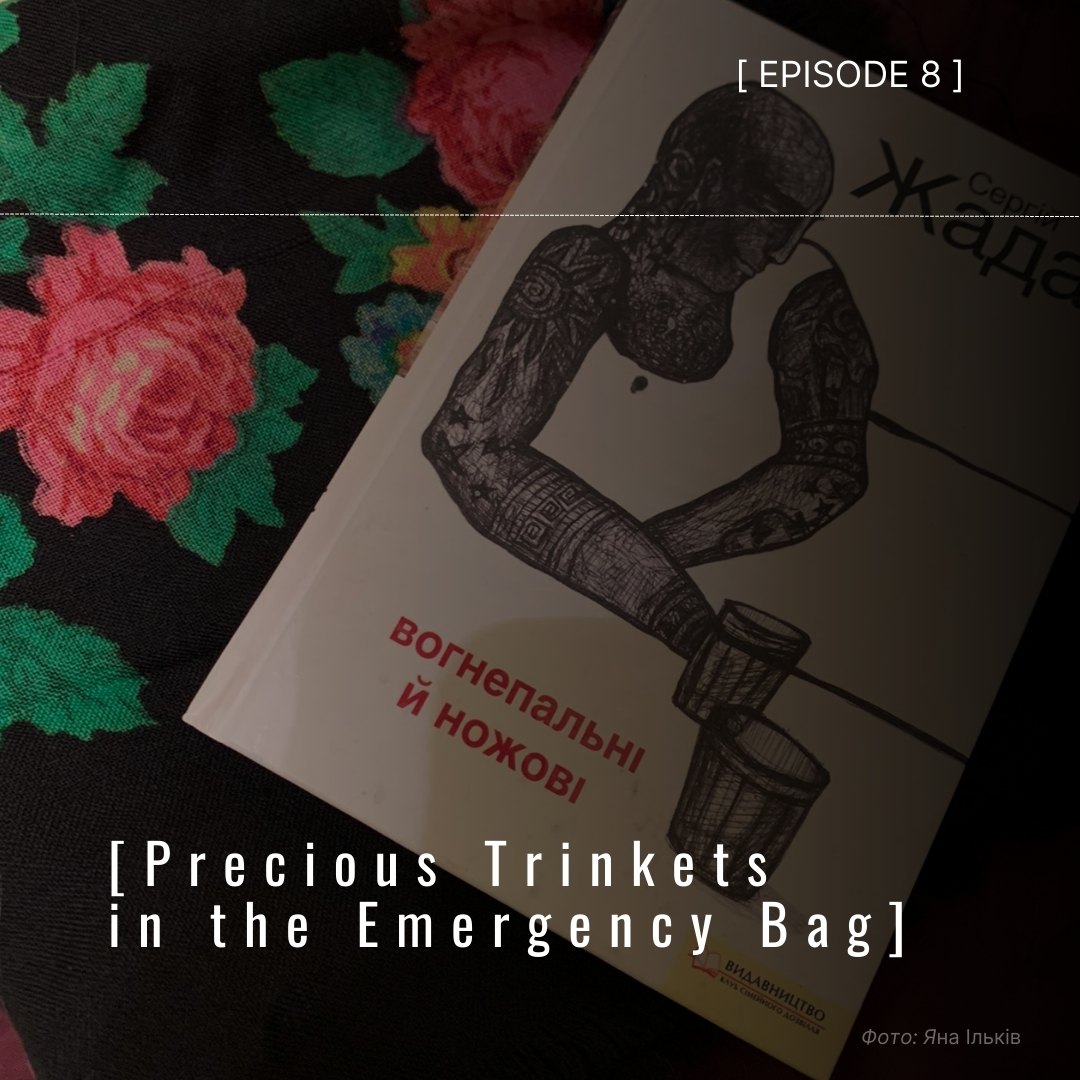
Episode 8. Precious Trinkets in the Emergency Bag
In the final episode of the podcast, we discuss those special items that each of us packed in our Emergency Bag, safeguarded during evacuation, occupation, or on the frontline. Items that may not hold any practical significance, but are important and valuable to someone’s heart because they connect to loved ones, recall acquired experiences, or help to stay afloat and believe that carefree days will come again.
Епізод на інших платформах:
Текстова версія:
My grandfather Volodymyr, my mother’s father, had a pocket atlas of Africa. A dark blue book with 200 small pages in a hardcover, which saw the world in Vinnytsia in ’90 – a year after my birth. From the age of five, I knew by heart all the capitals of all African states. When my grandfather’s friends came over, he would place me on a little chair, and instead of nursery rhymes, we had Addis Ababa and Antananarivo.
And he was the first to let me sit behind the wheel, found my first English teacher, brought my first writing desk – huge and heavy, very dignified, gave me a shelf for my first books. He was always my support and biggest fan, even when he didn’t understand or share the opinion.
My grandpa loved being behind the wheel more than anything in the world. He drove as a long-distance trucker all over the Union, crisscrossing it. I remember his Colchis a little and the motorcycle with a sidecar, and then there was a blue Zaporozhets, and towards the end of his life, a green Zhiguli. In his old age, he loved telling driver’s tales, and I loved listening to them, especially on the road.
Grandpa Volodymyr has been gone since 2014 – his heart gave out. From him, I inherited a wild love for the road, an interest in the Caucasus, potential hypertension, and that dark blue pocket atlas. He gave it to me when I started school. And since then, for about 20 years, he has been traveling with me through all the high schools, universities, and apartments, although he probably aged in the last century. And, of course, he has his place in my imaginary “anxious” backpack.
In this episode – the final episode of the podcast – we will talk about those special things for each of us that we packed in our “anxious” suitcase, took with us during evacuation, or carry with us to dangerous places. Those things that might not have any practical value or material worth, but are most precious to someone’s heart.
My name is Alona Savchuk and this is Mud and Blood podcast
The idea for this episode was suggested to me by a colleague on February 24th. It so happened that my apartment, situated near the railway station, became a significant transit point for me, frequently used by friends and acquaintances. During those initial days of the full-scale invasion – marked by chaotic traffic jams, overcrowded trains, and the closure of the metro – its strategic value increased manifold.
So, on the evening of the 24th, Nastia came to stay overnight with me from the left bank, with the intention of catching a train to Lviv the next morning. When I met her near the metro, Nastia had, aside from a carrier with a kitten and a bag of essentials, a pour-over and an old camera that had belonged to her grandfather in her hands. And later, while having tea, I also learned about the embroidered shirt in her backpack – a family relic that she packed first. Right then, I thought: it’s intriguing, the peculiar and impractical things people grab in such moments; I would love to hear stories about those special items.
On February 24th, I had a packed emergency backpack. More precisely, my now former boyfriend packed it for me. There were some essential items – everything for survival, you could say. Some clothes, and there was cash, you know. But as I was getting ready to leave the apartment, something crossed my mind. I thought that most likely the metro would be closed the next day – and it indeed happened – and I might have to travel from the left bank by reindeer. So, I needed to leave. I packed a few things for the cat – actually, for the cat – and I thought, “Well, if this is going to be my last time leaving the apartment, then maybe I should take something else, something valuable, something that means more to me than spare underwear,” you know.
The first thing that came to mind was to gather my jewelry. Firstly, they’re expensive, not only in the monetary sense, but also in the sense that they were given by someone or belonged to my ancestors, you know. And I gathered them, putting them in a pile. Then, as I thought about it, I realized that among the jewelry there was a ring that belonged to my grandmother, a gift from my grandfather. I thought to myself, “Oh, yes, I still have my embroidered shirt, which I retrieved from my great-grandmother’s chest,” and it’s very precious. I needed to fold it, and so I did.
It’s probably nearly 100 years old. I don’t really know its exact age. But I would like my potential grandchildren, if I ever have children and grandchildren, to see it.
Nastia explains that after her great-grandmother’s passing, her mother brought a large chest from the village, filled with blouses, traditional clothing, and towels. One day, they opened it and decided to go through the items that had been preserved from her great-great-grandmother and great-grandfather.
I don’t know their story. I just recall that when we opened those chests, my mother and I tried the items on. There were various blouses for different occasions. From what I understand, this one was for special occasions, given its intricate, vibrant embroidery. Somehow, my mother said that it would be mine. She chose a more austere, white one for herself, adorned with an ornament-like pattern instead of embroidery.
I simply know that if it was in the chest, it most likely belonged not to my great-grandmother but to my great-great-grandmother, as she used to do a lot of embroidery. And the towel, a sort of wedding towel – it’s actually her wedding towel, which she, incidentally, never used.
Regarding the towel – that’s a separate story, because I left it at home. And the entire time I was away, I scolded myself for not bringing my towel. I thought, darn it. It’s genuinely my wedding towel – well, it was meant to be a wedding towel, but I just took it and said, “It’s beautiful, Mom, this will be my towel.”
As it turned out, an embroidered shirt is not a rare item in the “anxious” suitcase. Regardless of whether it’s passed down through the family or purchased last May in a store. An embroidered shirt in your suitcase, wherever life may lead you – it’s like a piece of home that’s always with you, a connection to your people. Your people in the sense of “family,” “relatives,” and also in the sense of “fellow citizens.”
Alina also shares about her great-grandmother’s embroidered shirt, which she brought with her from Kyiv.
I’m not sure why I carried it along with me, to be honest. During the war, an embroidered shirt isn’t really practical, especially when the conflict begins in February. But I had this feeling that if it were to be destroyed in some shelling or left behind in my apartment during an occupation, it would be the last piece of my identity that I’d lose to these oppressors. I really wouldn’t want that.
Because there’s a part of you that shapes your viewpoints, a part that contributes to your experiences – all the intangible things that you can hold within your mind. But this item, every time I put on this embroidered shirt and people in public ask, “Oh, it has such an authentic appearance,” each time I proudly say, “It’s from my great-grandmother,” she embroidered it herself, this shirt is over 100 years old and all that. I think it kept me afloat a bit.
When I took it from Kyiv for the first time, I made a promise to myself that I would return. I’d come back – using the word “definitely” – with this shirt. And I’d celebrate in it after Ramadan. And that’s precisely what I did. In late April, wearing this embroidered shirt, I went to the mosque in Kyiv and celebrated the end of the fasting period there. It became one of my anchor points, a reminder that we’re managing, that we’ve endured through all that has occurred. I made a promise to myself, and I followed through. And I did it while wearing this shirt, my grandmother’s. I believe it has helped maintain my sanity.
Grandmother’s embroidered shirt, great-grandmother’s headscarf, mother’s jewelry, childhood film photos, handwritten love letters, a child’s drawing, or their toy – these things don’t provide any practical benefits during travel, in the basement, or in a trench. But these are the items that keep us connected to our dearest people, ground us, offer comfort, and remind us of the reasons to continue progressing and fulfilling our responsibilities. That’s why there’s always a place for them in a backpack or suitcase.
A peculiar sensation – I recall it – standing amidst a room brimming with belongings I had meticulously gathered over the years: books, vinyl records, photos, albums, paintings, an assortment of knickknacks from around the globe, and tokens from numerous individuals who found their way into my home. Yet, in reality, at that instant, hardly any of it carried much significance.
Nastia shares:
In truth, even prior to that moment, I used to contemplate the possibility of a time when I’d need to vacate the apartment. This thought had crossed my mind even before February 24th, and I pondered, “Wow, how will I leave all this behind?” So many books, a few of my notebooks, my films, vinyl records. I anticipated it would prove quite challenging for me. However, as I packed these items, the possessions I had amassed in essence, and as I prepared to depart the apartment, I reflected, “Well, you know, in reality, I don’t need much to sustain my mental equilibrium.” I recollect also reaching out to my former boyfriend and inquiring what he’d want to take from the apartment, what held meaning for him. He responded, “Oh, nothing’s necessary, don’t take anything.” And I thought, “Oh, come on, that’s not true, I ought to remember myself.” And it occurred to me that he had this toy. A small knight from a Kinder Surprise, from childhood. Not that it held considerable value, but for some reason, it was always with us. So, I packed it as well.
And when I stood in the corridor amidst all these backpacks and belongings, I noticed my grandfather’s film camera resting on the shelf. It had weight to it. Indeed, taking it along seemed like an entirely irrational notion, yet I surmised I couldn’t leave it behind. And so, I stuffed it into another bag and then departed. That’s the extent of it.
I traversed each room once more, took a final glance. I recollect that upon entering one of the rooms, it was after I’d secured the camera. I discerned photographs encased behind glass. Two images of me from my childhood adorned the display – in one, I stood with my grandfather and grandmother; in the other, my grandfather cradled me on his lap, while I savored some chicken. I slipped these two photos into a notebook and then proceeded to leave. However, the sentiment of forfeiting all my possessions and never glimpsing them again wasn’t present, truthfully. As I strolled through the rooms, a tinge of sadness enveloped me, but overall, I was content.
As you glance around, your eyes skimming, searching for something valuable, your gaze snags on an item. In a split second, your brain weaves a tapestry of memories and associations – and there it is, an entirely unexpected object that lands on the shortlist of things to rescue under any circumstances.
For me, it was an utterly ordinary champagne cork on the bookshelf. The first significant topic I worked on as a reporter was the Crimean political prisoners. For three years, from ages 16 to 18, I traveled to the peninsula, crafting extensive pieces about fabricated terrorism and extremism, raids, arrests and trials, intimidation and torture, detention centers and prisons, the efforts of lawyers, the Crimean Solidarity movement, and the lives of the families of the political prisoners.
This initial systematic field experience shaped me as a reporter, but even more importantly, it structured and honed my perspectives and values as a person.
In November of 2018, access to Crimea was denied to me. The FSB banned my entry into the occupied peninsula and Russia for a span of 10 years. At that time, it was a vile yet entirely predictable turn of events. I distinctly remember returning, on my way back, feeding a kitten kefir in the buffer zone between the checkpoints and then heading home.
Friends and colleagues greeted me at the Kyiv train station with a bottle of “Crimea” champagne – an attempt to ease the bitterness – and we drank it right there on the platform. I held onto the cork – a reminder of what we dedicate our lives to and why. When I saw it on the shelf in February, I unexpectedly realized that I had to preserve it.
For Aliona, an envelope containing her dog’s wool became an unusual memento.
Among the most intriguing items in my backpack – which probably wasn’t the case for everyone, though I won’t assert it – was a bundle of wool from my beloved dog.
Somewhere before the New Year, we celebrated our dog Hugo’s first birthday, our furry sibling, the dog of our lives. It was the start of his first shedding season. As I petted him, a huge clump of his fur came off – it startled me, as I had never witnessed a dog shedding before. I thought something was wrong, and from my fear, I tucked it into my back pocket. Later on, I realized that it was a natural process. However, in those jeans I was wearing that day, a substantial piece of his fur remained in the back pocket. When it came time to pack my backpack, I knew I wanted to carry this piece of his being with me, as I hold it dear above all else. So, I placed everything in an envelope – the fur, a photo, and a small toy that’s been with me since my first year of university, back in 2007.
I named it after my friend. It’s a teddy bear that travels with me between cities, accompanies me on journeys. I hung it on this emergency backpack to keep something from the absolutely carefree normal life.
An envelope with dog fur, a corkscrew, and a keychain toy that has been with her for 15 years, serving as a reminder of her former carefree normal life – these are Aliona’s collection of peculiar “anxious” things.
I wasn’t initially inclined to prepare an emergency backpack; I resisted it for a long time. No information or warnings compelled me to do so. When my best friend left for her unit on February 22nd, I realized that this was the pivotal moment. Still, I selected this emergency backpack, so that if war were to break out, it would be my worrisome backpack; if not, it would be my carry-on luggage for a flight to Cyprus. For the first time in many years, I was planning a two-week vacation in Cyprus. To enjoy the landscapes, to relax. Yet, it happened that the backpack fulfilled its primary function. And for me, it was essential for it to look appealing. That’s why I added a transparent window at the front, in which I placed a photo of the dearest being in the world – my best friend’s dog, my godson dog. I wanted to always have this in front of my eyes, to see and know that there is something beautiful in this world.
There was another photograph inside, featuring me, my friend, and our dog. I told her about these photos at 24 in the morning. She said she didn’t have any, and she felt really sad about it. Because I had just taken these Polaroids in my apartment, as I had them printed. We were delivering the first round of volunteer aid on the evening of February 24th, back when it seemed like Dnipro. I remember that there was a pile of various items there, and I passed on a huge amount of medication. I asked the guys who were transporting the items to the station to make sure they handed it over, as it was crucial – the photos.
Interestingly, we thought that this photo had been lost, but it reached her intact and undamaged towards the end of summer. Somehow, it got lost in those volunteer packages. I don’t know who kept it, how it was preserved, but it was with someone for half a year and still got passed along.
Marina shares that her “anxious” backpack initially included space for her ballet uniform, while the first aid kit appeared almost six months into the war.
Well, let’s put it this way, I didn’t really believe in a full-scale invasion. And I didn’t think I would need an emergency bag. I always carry a backpack with me, containing all the necessary items. I frequently move around the country, living in two cities: Kyiv-Chernihiv, Chernihiv-Kyiv. At that time, I was studying in Lviv. Therefore, my backpack was always filled with personal items that I might need.
Considering my active involvement in sports, I had my sports uniform there. In November of 2021, I started attending adult ballet classes because the pandemic was getting on my nerves. It happened during another wave of COVID-19. Although COVID was becoming less aggressive, the number of cases remained quite high. It was challenging for primary care physicians, so I decided to join the ballet to stay active.
In February, when everything started, I had a simple backpack with my ballet uniform. I was in Kyiv for work, and I had ballet practice later that day. So, the uniform remained untouched in the backpack that I packed on the night of February 23rd, which was a working day for me. It remained there for quite a while. And it became part of my emergency items.
During the summer, I began working with various humanitarian organizations. One of them provided each of us with our own first aid kit, and that’s how I ended up having tourniquets in my backpack. This was around half a year after the start of the full-scale invasion.
A special place in my “anxious” bag is reserved for items that help me stay afloat and remind me that all the horror around will eventually end, and normal life will return.
For Mary, a communicator at IZONE Media, it’s a piece of paper with a printed quote from Zhadan’s song: “Svіtlo skladaєtsya z temryavi, і zalezhyt’ lishe vid nas.” She carried it in her backpack for six months. This phrase is one of the key guiding principles for her life here and now.
Lena tells us about a postcard she received as a gift on the eve of the full-scale invasion and later took with her during evacuation.
The postcard had the phrase “The happiest you’ve ever been won’t be the happiest you’ll ever be” written on it. I thought for a while about how to translate this not just correctly and literally, but beautifully, into Ukrainian. I came up with something like “Якби щасливою ти не була колись, одного разу ти будеш іще щасливішою.” It was a very supportive postcard for me at the time, with an incredibly supportive phrase. When I was leaving my apartment, I took my notebook and placed that postcard in it.
The thing is, up until February 24th, I was absolutely happy. And it wasn’t just moments of happiness, but rather a state of complete happiness. It wasn’t a constant, permanent euphoria; it was a stable feeling that everything was good in my life. I was content with everything I had achieved by that point. I wanted to preserve it as long as possible. I was certain that it would continue to be that way.
Then the Russians attacked us, and I lost that feeling of happiness. When I was in the Netherlands for three months, I came up with a metaphor: it’s as if before the invasion, I was on a cruise liner that I got on and paid for myself. It was huge, equipped with all the entertainment I needed, and filled with people I was comfortable with. I saw that we were in the ocean, surrounded by the sea, and that something was happening in the world. I realized that I didn’t really grow up in sheltered conditions; I didn’t have any fantastic successes in life. Everything I achieved, I achieved on my own. Good people and opportunities always came my way. Slowly, I built my life, and by the age of 32 (I turned 32 in February), I had shaped my life in a way I could never have dreamed of in my youth or adolescence. And I thought that on the liner, but on February 24th, our liner was supposedly destroyed, and I found myself in a small boat, a lifeboat.
I think this realization that even a strong liner can be ruined overwhelmed me to the point that when I left the country for a while, I constantly wondered how to feel happiness again. I thought that I would never experience such happiness again. I often thought about those words on the postcard. It seemed untrue to me. I laughed at how naive I had been.
Then I returned home and moved to a new apartment. Gradually, I began to rebuild my life in Kyiv, even during wartime. Now, this postcard with those words is displayed prominently, and I occasionally think whether I can return to that cruise liner feeling. I’m not in a lifeboat anymore; I’m on a larger vessel now. But now, the knowledge that the ocean is mightier than any vessel, than any creature, and sooner or later, it will engulf us, prevents me from feeling happiness. Although I understand that the true art of being happy is to be happy despite everything. I really want to learn to feel permanent happiness again. Not excitement, not joy, not adrenaline, not the quality of swift achievements, but that deep, tranquil stability and the certainty that everything is falling into place in your life. And for now, I don’t know when I will be able to feel that again.
Perhaps each of us yearns for their pre-war life, or at least a part of it. It will never be the same as it was. And in general, the only stable thing in life is the absence of guaranteed stability. Once you accept that, life becomes a little easier.
But looking at it differently, it doesn’t necessarily have to be worse. Changes and crises can be both a threat and an opportunity. Sometimes, things are not as they seem at first glance. To always remember this, there’s a special thing in my imaginary “anxious” backpack. It’s a metal black ring with a pseudo-gemstone made of burgundy plastic. Of course, such a showy yet meaningless object has its own story.
A year and a half ago, my colleague and I were working in Syria. We visited closed Kurdish refugee camps where Ukrainian families were being held by force. While waiting for permission to cross the border, we had to stay in the Iraqi city of Dohuk for about a week. One evening, we decided to take a stroll through the side streets and stumbled upon a tea house for locals. Imagine a row of long tables near a precipice, occupied exclusively by men—around 40 people—sipping tea, watching the sunset, and discussing their matters.
Women weren’t accustomed here, that’s clear. Based on previous similar situations, I knew how to dress and behave, but a fair-skinned European woman in such places is like a unicorn—everyone’s genuinely interested in getting a closer look, yet at any moment, someone could take offense due to disturbances of public order, let’s call it that.
The tea house host quickly ushered us to a table. The guests from afar, it was a rare amusement. As we conversed, I tried to ignore all those dozens of watchful glances. However, one of the men was particularly stern, constantly peering at us with his dark eyes from under his thick furrowed brows.
At some point, the discomfort overpowered all other feelings, and I realized I needed to break the ice. So, I asked the host to translate that he had a beautiful ring and it suited him very well. And in that instant, a real biblical miracle occurred. In a second, his severe face transformed into the most beautiful smile you can imagine, like the sun breaking through a storm.
The man immediately took off the ring from his finger and handed it to me. To examine, I thought, but the host explained that no, it was a gift. And if I were to refuse, it would be a huge insult. We spent several more hours drinking tea and talking about everything under the sun, and in the end, he asked for a photo together.
This ring now accompanies me on all my trips, whether they bring happiness or not, and to all the meetings and public events from which I expect nothing good. It serves as a constant material reminder not to fear and to remain flexible. Because sometimes, things aren’t as they seem at first glance, and you can never predict where life will take you and who you’ll meet around the next corner.
This was the final episode of the podcast “Mud and Blood.” In it, we talked about those special things for each of us that can’t be sold for a fortune but are cherished at any cost because they connect us with our dearest ones, preserve memories of our experiences, or help us stay afloat and believe that someday a carefree, happy day will come.
Thank you for listening and sharing your stories and reflections on what’s happening around us, for observing and noting the day-to-day life during wartime in real time, along with us.