Episode 4. Parenthood at war
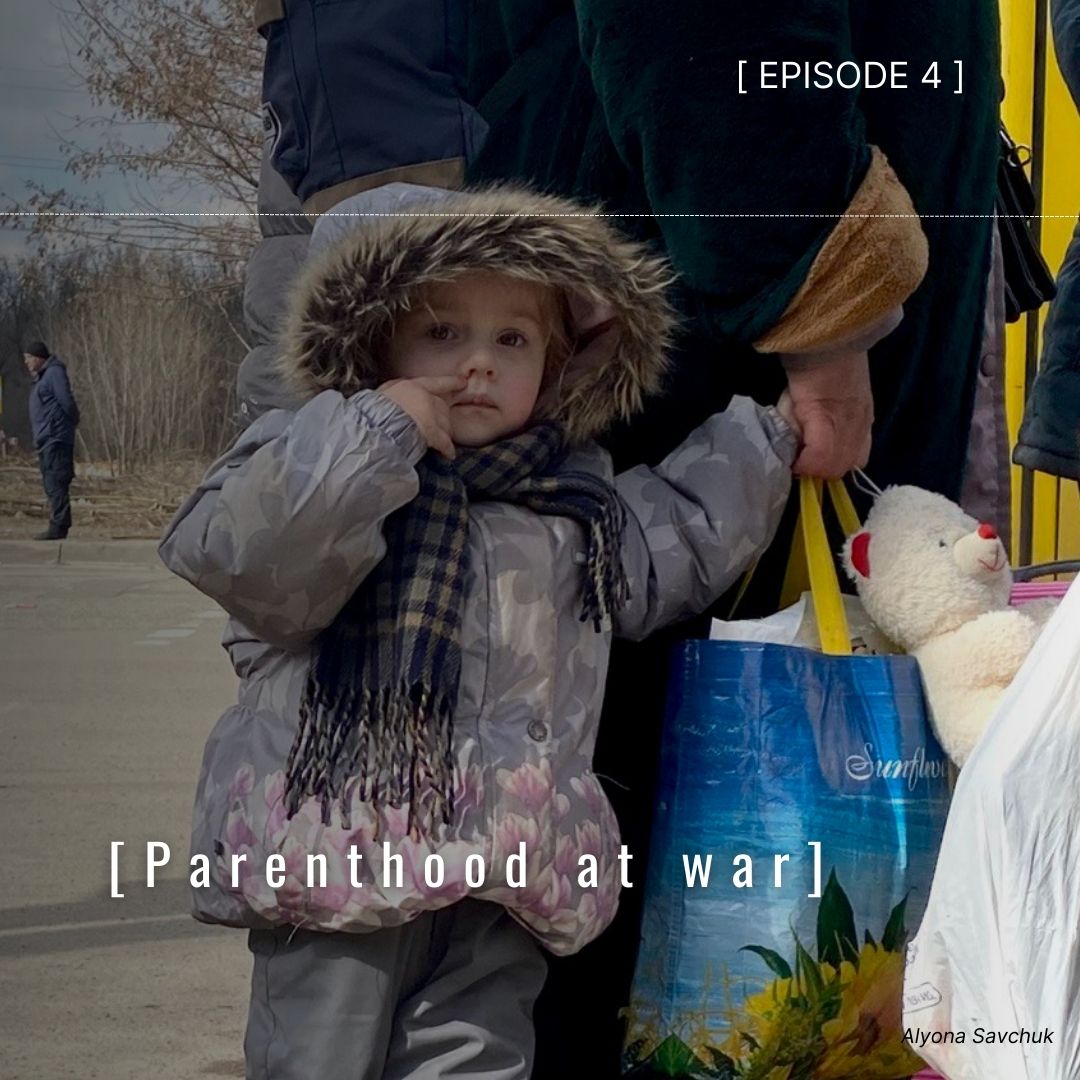
How does one choose between giving birth in the basement or in an unfamiliar place, relying on random strangers? How do you explain to a kid why we need to run to the shelter when mommy’s phone makes an awful, piercing noise? How do you answer a teenager’s reasonable question: why hasn’t the world stopped Russia yet, and when can he see his friends again? This episode is about choices and challenges, which parents of little Ukrainians have to overcome almost every day.
Епізод на інших платформах:
Текстова версія:
My biggest fear is my child getting sick. What will happen? How will I explain anything? Because in a maternity ward doctors brought me to tears, because they would start to tell me something about my child in Polish, and I just couldn’t understand.
***
On the road, when I was going to my son, I was texting my brother about the green notebook, which I really wanted him to give to my son — “in case anything happens”.
***
Of course, without a kid it would be easier in this situation. I would be at a commissariat the first day, and by now would have been, hopefully alive, but with a rifle in my hands already. But I don’t regret anything. It’s children. I love children. If I had 10, I would love all of them.
***
For us, every evening is an evening of such discussions. I’m tired already, I can’t do it anymore, but we continue.
A: Being a mother or a father is already a challenge, being a parent during the war is, in my opinion, a real accomplishment.
Every day, the Office of the Prosecutor General updates the statistics of children killed and injured by Russians. The number continues to grow, and at the time of recording this episode, it has reached more than a thousand. Although, how many more such cases there are, no one will ever know: in towns and villages razed to the ground, in occupied, gray, zones, and also kidnapped to Russia.
And besides, how do we measure the children’s trauma from what they saw and heard? From hours or days spent in fear in a basement or a shelter? From the lack of food, water, medicine? From the loss of relatives and the old lives, that they have lost running away from their cities?
The UN states that more than 6 million people have left Ukraine. UNICEF has counted 1.8 million children who have become refugees and 2.5 million more displaced inside the country. Stop for the moment, and just take in these numbers. 1.8 million kids — it’s 2.5 times the population of Lviv. And there are also children who have been born abroad, because many women ran away from shellings and the prospect of giving birth in the basement.
It saddens me to see this statistic, and it’s horrifically painful to read the stories of the individual children that make up the statistic. I can’t imagine how hard it is, and what an immense responsibility it is — to be a mom or a dad during this time. This is the topic we chose for the third episode to talk with people who have such experience.
My name is Alyona Savchuk and this is Mud and blood podcast.
Anna Tsiatsko was a communications manager for the healthcare reform on the team of Uliana Suprun, and later at the Ukrainian Healthcare Center. Now Anya is actually also a refugee in Poland, even though she doesn’t call herself such, and a new mom. Her son Illia was born a month to the day after the beginning of Russia’s full-scale invasion of Ukraine.
Two weeks before February 24, my friend, who knew that I was 8 months pregnant at the time, wrote to me to pack up and go to Western Ukraine. Me and my husband though for a long time, talked deep into the night about what to do, and I decided that I can’t leave. It’s my city, my country and I chose a maternity hospital here, here is my gynecologist, I’m going to give birth here.
We had a backup plan, my grandma lives near Kyiv, in Bilhorodka, it’s on the Zhytomyr highway, but in the opposite direction from Irpin and Hostomel. So we packed up and went there.
A: It was the morning of February 24. In the beginning Anya thought that they’ll spend a few weeks outside the city, wait for everything to calm down and come back home. But when their house in Bilhorodka was shaking from the explosions in Hostomel and a friend was recommending videos about home birth, Anya realized that it could actually happen. Her mother-in-law was calling and convincing them to go to Poland, to stay with relatives.
In one moment, my husband was sleeping, it was deep into the night, the news came out about the nation-wide mobilization. I understood that it won’t be over in two weeks, and not even in three. It’s a big, long war.
So I woke my husband up, we used Google to plot the itinerary from Bilhorodka to Bialystok. Google suggested we go through Yahodyn border crossing. And we have decided that we are going simply in 5 minutes. The situation was that it wasn’t clear, maybe if we wait an hour or two, we won’t be able to leave at all, what will be on the road. It took us 15 hours to get to Kovel. There we left our friends, rested for a bit, and then it took 30 hours to cross the border.
I’ve never before in my life seen anything like this. It shocked me so much, it shook me up more than the explosions I saw in Kyiv. The cars and in every car a woman driver and 3-4 children, hers and someone else’s. And many women with teenage kids and tiny children, around 2 months maybe 6-month-old. So she, that woman, also stands 30 hours in the line with that child. It’s impossible to describe, it looked like an apocalypse of sorts.
A: Once I came across the Instagram post of one of hundreds of thousands Ukrainian women who left to take their kids away from the war. It was a short video of kids sleeping in the backseat of the car that is heading into the unknown. The sun shines on the kids at the edge of the frame, the car is swaying softly. It’s a calming, even meditative image, safe from the caption: “This two months long road made every Ukrainian woman strong”.
I think that if I couldn’t have left with my husband, I would have stayed in the western Ukraine. I know women that left to give birth in Poland, alone, or with older children — one gave birth in Hamburg recently — honestly, I can’t imagine. I think these women are incredibly strong.
To answer the question of how I could leave with my husband. He is a citizen of Belarus. I say that it’s the only advantage of Belarus’ citizenship, that we could leave together.
A: Despite the family staying together, giving birth in the foreign country was incredibly hard for Anya. In the beginning, she didn’t understand Polish at all, and finding someone who speaks English in the village they settled at wasn’t an easy task.
Later I also found out that that my husband won’t be allowed in the delivery room, but we were planning on a childbirth with a partner. It got me even more upset. Because my husband knows a little bit of Polish and could have communicated with the hospital staff. And he wouldn’t have been in such a stress, so he could communicate at all, yeah. I was horrified awaiting the childbirth. Exactly because of this communication barrier, lack of understanding what are they going to do to you. I got to the ward and turns out that at that shift, absolutely no one, not a single nurse, spoke English, only Polish.
It so happened, that during childbirth it was decided that I needed an urgent C-section. They couldn’t take me to surgery without my consent. And to get it, they first read out all the possible negative side effects. At this point, the doctor came up with an idea to use Google Translate to read it out.
Of course, the delivery didn’t happen like we have planned, like we have wanted. And to be honest, all that helped me stay calm then was that I wasn’t giving birth in the basement with the sound of air raid sirens and under bombs. All these stories are incomparable. Although I, of course, think that no Ukrainian woman, and not only Ukrainian, deserves to flee and give birth somewhere she didn’t plan, because it’s very important stage, very hard moment in the life of every woman, and she deserves the comfort.
A: The endocrinologist, who Anya was seeing at the maternity hospital, helped them find an apartment. She organized it in a day’s time, even though previously the family have been searching for a place for 3 weeks. The same doctor supplied Anya with anything she needed for Illia’s first year and helped to set up the household.
Sometimes people want to help someone personally. Needless to say, the Poles donated, there were countless centers. They donated everything, they brought, it seemed, everything and all they had at home. Clothes and anything under the sun, and groceries at the store. But it’s one thing to buy and donate, and another one to help a certain person, maybe she liked me. I don’t know how many friends she has, but, to put it plainly, they gathered and brought me everything in one day, the room was full of stuff. They have brought me everything. Baby clothes from 0 to one year. More than one child can go through, a stroller, toys, special underwear for breastfeeding for me. They specifically asked for my size, so it would be comfortable, all the vitamins I needed. When after the childbirth, a nurse came to the room with a list of what I needed, I opened the bags and I had everything. They brought dishes, bedsheets — anything you can imagine, small stuff, kitchen towels, knives, all such stuff. She took it to heart and gather stuff as she would do for herself. It was really touching. She still messages me: her son is one year old, she has a lot of stuff, diapers left over, I’ll bring them to you, she says. We grew out of some cot, I’ll bring it to you. Don’t buy a high chair, I have one for you.
A: Anya understands that in many regards she’s incredibly lucky. But it doesn’t drown out the deep feeling of injustice and the great loss of her life. And also fear for the future of Illia.
I had a concrete objective, I had to leave, to be healthy, to have nothing happen on the road, not to go into labor. And as soon as we reached that objective, it all flooded in. It’s truly difficult to understand, for people who are in Ukraine, and for us to understand them, because we don’t know what it’s like to live under the constant fire, danger, hear those sirens but at the same time it’s hard to explain what it’s like, when it’s all happening in your country, and around you people are living their usual lives. Before Illia was born, I couldn’t go into the town, go to a store. It seemed like a mockery to me. It was impossible to tune out and pretend that everything is alright, that you are living a normal life.
Month before Illia was born, month of war, it was unbearable. We all were just reading the news. And to make yourself do something, besides donating to Ukrainian Armed Forces, Come Back Alive, was impossible. I was still trying to work. I don’t know how people work. I could hardly do it.
For the last two months, I wake up and live the life of my child. I try, only in the evenings I have time to think about the future and take in what is happening. In this respect, having kids is a great advantage. Because they distract you and anchor you to them. You have an immense responsibility for the helpless creature, that depends on you.
The drawbacks are obvious, if I didn’t have a child, I would have been home, in Ukraine. I wouldn’t have left. Maybe I would have been a medic, gone to a tactical field care courses. My husband is a good shooter. So we would have been ready to fight. Currently, we, unfortunately, can’t. Unfortunately and luckily, two in one, it turns out.
I understood that I needed to focus. Because we have already left, we don’t live in the war, so there is no need to bring the war into the child’s life with these emotions. Although, obviously, in the first month Bucha, Irpin happened, when these towns were taken back, the first month I couldn’t handle it. It was more than I could bear, and still I couldn’t lay down depressed and crying. Because while the kid is asleep, you lay down, read news, cry, he woke up, and you can no longer cry and be sad. He doesn’t deserve it, see, he was born, and it’s not his fault he was born in such times, and he doesn’t deserve it.
A: The family doesn’t plan to stay abroad. But they also can’t make a decision to come home for good yet. Mostly because of the bureaucracy. Anya says that they are afraid to come home and lose the special status they have in Poland, and in case Russians try to take over Kyiv again, they’ll have to go through it all again. Besides, her husband as a citizen of Belarus can be denied entry to Poland without a visa. In this limbo, Anya has spent spring, and now summer.
I’m very fortunate, not many women are, because I left with my husband. So we don’t have such an urge to go home. I understand deeply women who go back because they want to be with their husbands. I don’t have such a need. My husband helps with a kid, a lot. We get by. But if I was told right now, “You can go home”, I would, right this moment, get up, get my stuff and go home. I feel very vulnerable, insecure, that’s firstly. Secondly, I feel isolated. And thirdly, I’ve never… there are people who want to leave and live abroad. I’ve never wanted to. Nothing but mine. I love Kyiv so much, I waited many years to give birth. I’m 33 now, I could have had a baby much sooner. I did it intentionally, because I wanted to do it as comfortably as possible. I predicted everything, planned, built, and it was all for nothing. We are back to square one. And, with a little baby it’s impossible to make connections, to start a new life. I’m in a constant state of wanting to go home.
Now we are in the stage of war when it’s obvious that it’s impossible to rationalize and say it was dangerous yesterday, but it’s safe today. And even with some agreements, we all understand that half of the country is mine-infested, and to sign anything with the Russian Federation — isn’t a good idea, and doesn’t guarantee anything. That’s why now the choice is between living abroad and building a life here for a few years, and staying here, or accept that we are coming back to the country where there is a war, where war can stop for some time, and resume again. And the choice is between who is ready to live in these conditions, and who isn’t.
From here, it’s impossible to make a decision if we can live there. We’ll go and see. I have a grandma, who is turning 93 in August. She’s my only close person who is left in Ukraine. I really want to see her. She really wants to see Illia, I think she has lived for so long just to see my child.
***
Hi, everyone, my make is Olena, I’m 33, my child — Daryna is 3 years and 10 months old. I have worked for a pharmaceutical company for more than 10 years now.
A: Liena with Sashko and Daryna live — lived — in Kyiv, in a part that isn’t the best, safety wise: there are several military objects nearby. They are both from Volyn, so the decision has made itself.
We left on the first day, but in the evening. We hesitated for a long time, should we go, or should we not. And decided to go. In the evening. I didn’t want to. Maybe it was a shock, maybe because I understood subconsciously that it’s for a long time. So. But from the point of view of child’s safety, it was a thought-out decision. The first days were hard. Because we were so stressed. And, like, we tried to be calm, but the child feels it. Emotional background of sorts, and moreover, everyone has heard the explosions. Then she got sick. For a while we were just recovering from it all. Now we are in the framework of understanding what is what.
I’ve asked all the parents I talked with for this episode two questions: what advantages, that aren’t obvious to me, has parenthood in wartime and what they find the hardest right now. Especially those who have stayed in Ukraine.
Actually the child helps, in a way, to find strength to continue living. It’s the main plus. If I didn’t have it, it would have been harder. And it’s already hard as it is. So. And minus, if you can call it so, is the limitation. Limitation of mobility, because in the first place, for parents, is safety. Always. It’s something that you carry with you from the birth of the child. You have to always take it into consideration.
A: Currently, in day to day life, what is the hardest for you with Daryna?
Her constant presence. I work remotely. It’s both a plus and a minus. Because before the war, we had kindergarten, and teachers were responsible partially for education and entertainment. And now it’s all on my shoulders. So it can be a little bit hard, can be hard. Your attention is constantly required. And if you have a meeting, it isn’t easy. You can explain, ‘daughter, mom needs some time’, you need to find some appropriate activity, but she’ll still distract you.
A: Similar story I heard from Ihor and Alina. Their son, Leonid, is 4 years and some.
What is the most difficult right now?
Now? The fact that kindergartens are closed (laughs). It’s hard to work and have a kid. We are very lucky that my father-in-law has such a job that he can also babysit the little one. But not always, so I take him with me to work sometimes. And it’s both an advantage and disadvantage, because it’s almost impossible to work. Because I don’t work in the essential infrastructure, we were told that we can’t take him to kindergarten, until the war is over. Otherwise, it’s A-OK. Gas collapse, transportation collapse. We bike everywhere, with a child safety seat, sport life. It is what it is.
Of course, without a kid it would be easier in this situation. I would be at a commissariat the first day, and by now would have been, hopefully alive, but with a rifle in my hands already. But I don’t regret anything. It’s children. I love children. If I had 10, I would love all of them.
*
Did we have any household changes? To be honest, besides moving, not at all. Yes, the kindergarten is closed, they plan to open in August or September, it is equipped, so the kids can take shelter in the basement during air raid sirens. Speaking frankly, I don’t have much trust in the kindergarten basement, but still I trust more in the part of the city where the kindergarten is, because I see the statistics of the shelling of that part of the city, and it’s minimal. On the other hand, practically anything can happen right now. To predict when there will be a strike today, where it will hit tomorrow, who is more safe and who is less — it’s extremely hard.
At the end of the day, I can say that I, as a mother, got very lucky — well, let’s put it in quotation marks — I was lucky that Lonia’s father didn’t go into the Armed Forces or Local Defense Forces. During some of the hardest times, he volunteered, but he could be home and take care of him. I also have two of mine — one can say — energetic and ready to help parents, who, probably, in all this time, during these 100 and some days, they were really active at helping me with my son. We also have another grandma on standby.
Another plus, is that my child, he isn’t tied to one home, relatively. He can now stay with his grandparents in the suburbs in Central Ukraine, and it’s, at least for me, easier, mentally. Let’s say, this particular city during the escalation was shelled, probably, two times, the outskirts of the city, and it went by without ruination, losses and any negative emotions for my kid and my parents.
A: Alina has worked as a photo reporter for several years now. So she has experience getting out of different dubious, from the safety perspective, situations. Since February, she often works in the field and is generally used to the idea that the strike can happen somewhere nearby, and used to what picture the strike leaves behind. But when you aren’t in the work mode, but at home with the child, it’s a completely different point of view on the situation.
I was sure, up until recently, that in deoccupied Kyiv it is more or less safe, not to live there continuously with a child, but at least spend some weekends there, spend the night, and not be super anxious because of the sirens. Just follow the information, and somehow live with that.
It just so happened that I’m recording this part on the day when 4 missiles struck Kyiv, there were probably more, but the four I’m talking about, they all struck the part of the city where I live now. I, actually, heard this sound at 6 am. I was awake already and saw a missile flying by. And it radically, not a 180 degree, but seriously changed my belief about the relative safety of the place where we are, and about Kyiv, and our part of the city and other such things. And the first though I had, in the chaos after seeing it all, after you hear the sound of explosion — well, I had experience, I’ve heard explosions from somewhere afar, and closer, how air defense works, how street fighting sounds but particularly the high caliber missile hitting a residential building, that is right next to me, it was a first time for me — and to put it lightly, it was unpleasant experience. And the first thought I had after all that “pun on shoes, grab that, do I have documents, where should I run”, the first thought was “what would I do if my child was with me now”.
To be honest, I don’t know the answer to that question. Because focusing on such situation is extremely hard, especially, if it’s a new house. I don’t know where the basement is, I didn’t learn these things yet.
But I imagine exactly the same situation, how I would do it with a small child, but I can’t imagine how he would react. Maybe he would get scared, maybe something else. But the logistics itself of moving and how I can find a safe place for him, all that stuff, I can puzzle it out in my head. And even before, I understood people who take their kids and go abroad, especially the women who have two kids, who stay alone with those kids somewhere abroad, or in other relatively safe regions, but now I, I just think that something has clicked in my head or something. And I am sure, for some reason, that if I had experienced today with my child, we would already be somewhere halfway to Transcarpathia. I would organize, and arrange everything to take him as far from this place as possible.
4 years old is the age when the kid gets tired randomly, can fall asleep anywhere, but he’s also already about 20 kilos, and it’s hard to carry him, if we need to run somewhere, run from something.
A: This kindergarten age is especially interesting in one more aspect. On one hand the child is old enough to understand the danger, anxiety of the parents, learns to communicate own needs and fears, but on the other hand — the child still can’t understand more abstract stuff, such as war, homeland, sovereignty or independence. So how do parents explain to kids of this age what is happening?
He knows that there are some criminals who fly in on planes and destroy houses. And there are police officers — for some reason, we decided to call them so — who take off on other planes and try to intercept them. So. We support good guys and girls, police officers who have their own planes, and we don’t like the criminals.
I am, probably, calm and content because I see that he hasn’t changed in this time, so he isn’t traumatized but this experience. He, as I see it, feels as adequate as possible in these circumstances. Only one time, I think, he was in the situation when adults he was with heard explosions, it happened in the middle of the night. My parents wrapped him in the blanket he was sleeping with, it was about 2 am. They took him to the basement, so. But he slept through it all. See, it’s like, it always goes past him, and it’s probably quite egoistic, because I see what difficulties other parents and kids encounter, but I’m happy for my child, that he doesn’t have to go through it.
A: Your kid, he’s 4 now, he already understands something. Does he ask you anything? Questions you? How do you talk it out with him?
— You know, I think it’s useless to tell a 4-year-old kid, to explain what is war in a precisely correct way. But I pick up some epithets, like … It’s all really simple bad people have attacked us, using kid words, for him to understand that there is nothing to worry about, so he can continue to think about his toy tractors, balls, bikes, and not worry his head about it. But I still try to explain what it is.
It was difficult to explain air raid sirens. Because we live next to the institute of special communications, and it’s a strategic military object. The sirens wail so loudly. So at first the kid got scared shitless. I explained to him basically that it is an air raid siren, there are even cartoons about it now. The only thing, he learned, and he now professionally recognizes Ukrainian flag now, and can’t stop talking about it. Let’s say, his patriotism grew.
A: On the similar level, Liena and Sashko explain to Daryna why they live with grandma now, and why do they need to hide in the basement during the sirens.
Of course, we talk it through. But you know, in the minimal format. Because due to her age, I see no point in explaining the cause and effect in any more details. Currently, simply in the form of statement: Russia is our enemy, the people who came to our land are invaders, she knows what a missile is. It is good that we can turn it into a game. She’s currently, let’s say we have to turn on cartoons for her for some time, more often than before the war. So. There is a cartoon — “The Lion Guard”. And there are lions and different such animals, and they roar. So Daryna imagines that she takes down missiles with her roar, and they won’t fly here.
She got older, it’s well, it’s logical. Because it is an age when kids grow two or more months in the span of one. You know, maybe it’s going to sound weird in a way, but, well, I saw a kind of awareness in her eyes. Well, like when you answer her questions about Russia, missiles, armed forces who protect us. She, by the way, likes a lot the ads on TV about Ukrainian military, tanks, she likes to watch it, and she says that they are helping her parents.
You know, it’s like it’s weaved into her subconscious, she seems to generally understand what’s happening, she accepts this fact and like in a grown-up way, I don’t know how else to say it. — This is her level of understanding, this is her reality, she lives with it. And that’s all.
No one would have wanted that. But we don’t have any other reality. We live with it.
A: Halynka is also a young mother of two kids: her son is 5 years old, her daughter will soon turn one. She weighs the pros and cons of her status so:
With children it is more difficult and with children it is easier. It is easier in the sense that with kids you really grow wings, they with their love, their smiles, their laughter, their … It seems to me that when I touch them, I physically recharge from them. And even if you take away this energetic superpower of children that they give, just that I get distracted to wash up, care for them, feed, cook and read a lecture, pity them, give a kiss, a fairy tale, a song, change clothes, put to bed, time has passed, my the attention was not focused on the war, but on something funny, busy — and I am already grateful to them for this.
On the other hand, it is more difficult with kids, because they are much more vulnerable and there is much more to do with them. Because when you are unbearably scared, shaking from the sirens, well, the first time my reaction to the sirens was shaking, I had tremors, and the child was crying. I had to calm her down, but I was shaking myself. And how to bring myself to sanity and calmness, to some adequate state and how to give a child something in this state — well, it was extremely difficult. Thankfully, my husband was there, thankfully, my parents were there for the support.
Be that as it may, the parental identity changes the attitude towards what happens, in general, to the Ukrainian children. Even if it’s involuntarily, damn it, you try those stories on yourself, the most terrible stories. I don’t know if it’s how our psyche works — to try on the most terrible thing on yourself, to have the illusion that you can come up with some antidote to this horrible story, some antidote to avoid it. I do not know.
But someone has said, that every child is everyone’s. And the truth is, my heart broke for every child who suffered from the war and continues to suffer in this atrocious, brutal war with Russia.
A: It so happened that Halyna and her daughter met February 24 separately from her husband and son — the boy wanted to visit Sasha’s parents, and so he took him there. She says that it was a horrifying moment for her.
*
When my husband arrived, we went to our in-laws, and not to Western Ukraine, as we had previously planned. We went 150 km from Kyiv, thank God, we were lucky that the parents live south of the capital. On the morning of the 24th, I was woken up by my father’s call, at that moment I had not yet heard the explosions. After the conversation, I heard car sirens start screaming in the yard and I heard explosions. At that time, I had a five-month-old daughter in my arms. I was petrified for a moment, and then I sang her “Belt after belt” (note: a Ukrainian rebel song) as I rocked her.
On the road, when I was going to my son, I was texting my brother about the green notebook, which I really wanted him to give to my son — “in case anything happens”. In this notebook, records my feelings and thoughts about my son, I have been keeping it since pregnancy. It seemed to me, at that moment it seemed to me, when I was pregnant, I wanted my son to know how much I was waiting for him, how much I love him. Then I wrote down his first words, some cool ideas, events. And I wanted him to know it all. Those terrible moments when you give out instructions in case of your death.
A: Teenagers are a separate world of parenthood. It’s not easy with them anyway, and how it is in the conditions of war, constant stress and survival mode — to be honest, I don’t even want to imagine it for myself. This world was opened to me by Lidia, mother of two: Varia is 10 years old, Liubomyr — 8. The boy is disabled, and requires daily injections of hormones and taking pills. So Lidia took the children to Poland in the beginning of March.
Our decision was determined primarily by the availability of medicine. When interruptions in the supply of medicines began in Ukraine, we got very nervous. And my husband and I, taking into account all these circumstances, decided that I must ensure that his therapy is continuous during this time. And we left for Poland.
Firstly, it’s close. I have a feeling that I can get into the car and drive to the border literally very quickly. Secondly, Poland is such a country in terms of the standard of living that I can afford to pay for everything myself, earn money for myself and two children, rent a modest house here with my own funds and not feel that I owe anything to anyone, that I’m taking up someone else’s payments, I can go without receiving financial assistance and at the same time to feel comfortable as an adult, independent, able-bodied person.
A: She says, that despite the fact that the kids are old enough to negotiate with them, despite the fact that they clearly understand that there is a war in the country, that they have to leave everything and look for a safe place, it was extremely difficult for them to move.
I have wonderful grown-up children of 8 and 10 years. They go to school. They took the move very badly, because at first they were a little scared, well, like all of us after those basements, air raid sirens and packing to-go bags. They were under stress and at first it was quite natural that we started moving somewhere. I explained to them that it was necessary to move to a safer place.
I did not wait for the children to actually experience any, God forbid, destruction, catastrophe or anything else. I think normal parents should anticipate this and not wait for it. Therefore, my children did not see anything terrible. And very quickly, at first I stayed with my friend, we lived at her house and were looking for a place to rent. We searched and searched, and, obviously, when they realized what they had lost — and they lost a lot, they had a very comfortable wonderful life, full of positivity, friends, sports, school, their own space, a comfortable apartment, travel and everything under the sun — and they realized that they had completely lost it. They lost their environment, they lost their dogs, partly family members, friends, they completely lost this bubble of theirs. And here began the endless suffering because of the loss of his universe.
Plus adapting to the new school. For anyone, a new school is stressful, and a foreign language school even more. But here I have to give big one, I don’t know, just 5+ to my children. Firstly, they adapted well to school. By the way, we changed schools twice. First, for a couple of weeks, where we lived as freeloaders at someone else’s apartment, and then we moved to a rented one and went to a different school here, in a different town. They did adapt at school and completely successfully learned the language in these 3 months, in a regular class, on regular terms, they studied and finished the year decently.
And the second — they immediately said, suffered a little bit, and then said: God, what a wonderful life we had, the most wonderful toys, how cool it was in Ukraine, what a beautiful city we had, polite dogs, how wonderful everything was there. To put it shortly, they became so appreciative of those everyday routine blessings that they had, which they completely ignored like any average modern well-off child. Everything comes from nowhere: you open the fridge — there’s food, your wallet — there’s money, you go to the sea on holidays, to Egypt, and it all happens by itself — all these roller skates, scooters, skateboards, birthdays. And all this comes out of nowhere.
And here they simply felt on their skin how cool it all was. And they began to have such philosophical thoughts about, in general, about what the quality of life consists of, what is important to them and what is secondary. And I think to myself: ooooh, I really feel sorry for you kids, but I’m glad that you gained a little bit of appreciation for everything that you had and understood a little bit the contribution that my husband and I made.
Therefore, on the one hand, yes, it was very painful, there was a therapist, and tantrums, and bullying at school, and tantrums every evening, and total pessimism. We have experienced a very difficult period of adaptation, but it is quite normal. That is, currently, my children are already calm, adapted, they understand that it is possible to live here, although at first they screamed and sobbed that Poland sucks, that it is terrible here. In short, what is bad here. And now they are way calmer about it.
A: Lydia says that Varia and Liubomyr are natural science oriented kids. So they have an incredible number of difficult questions to which she has to find answers herself.
For us, every evening is an evening of such damned discussions. I’m tired already, I can’t do it anymore, but we continue. And I think that my children will never understand this. Just like I can’t understand it completely. Because from the point of view of basic logic, it is absolutely incomprehensible, it is as stupid as can be and I don’t know, I simply don’t know, one has to be completely inadequate and not of sane mind to somehow explain it. It is counterproductive, it has no benefits — neither primary, nor secondary, nor tertiary — I can’t see them. And I can’t explain it to the kids. But they ask about it.
Because of what, why? If they want to get the factories, why are they destroying them? If they want resources, why do they burn them? So, they have very deep questions. I have very cool children. They are very smart. And the questions they ask, they periodically put me in a situation when I want to say: “well, just because.” But I don’t, I look for answers to them and I see that, unfortunately, infosphere does not deal with such answers.
A: At the same time, Lidia finds an incredible lack of general education projects for children specifically for teenagers, so that some of Varia’s and Liubomyr’s questions could be professionally covered by experts in the topic — for example, historians and behavioral psychologists.
I try to shield them, firstly, from crazy propaganda, and secondly, from shock content. That is, the visuals that I do not consider necessary for them to see. Sure thing, they are completely intellectually developed people, and they understand what is happening. And they ask the questions: why so? why are there wars at all? and why do people behave like that? and how can this be prevented? and why are there no negotiations? and why are the negotiations ineffective? You see , they ask very deep questions about why elections do not work? why is there no democratic government election mechanism in Russia? Why did this happen? How do people get caught up in such low quality propaganda? How do they believe this at all? Do they read anything there besides the news in their Russia?
The drama is that my family, if we go beyond my children and husband, are people who live in the Russian Federation and the Republic of Belarus. And unfortunately, my family was taken away from me by TV and I no longer have it. And it is very scary when you understand that a person is completely brainwashed and cannot take in the situation.
I understand that mutual propaganda is very powerful. We have to maintain the fighting spirit, depersonalize, dehumanize the enemy. It’s normal, it’s normal processes, but it’s so, well, it’s not even my 8-year-old son’s level.
I would really like it to be explained to children not just that we are Ukrainians and we are the best. It’s obvious, they already know it. They know the anthem, draw a flag and sing “Oh, the Red Viburnum in the Meadow.” But it isn’t enough.
If we don’t make some really cool content for kids specifically environmentally friendly, non-aggressive, I think that it will be difficult to live through this and come to the conclusion of “never again”.
It can end in trauma, constant hatred, fear, xenophobia forever. Come on, I remember that when I was very young, we still played the Germans and “ours”, it was the end of the 80s and the beginning of the 90s. And it was very, very unpleasant, difficult and painful, if you were assigned to play for the Germans. But absolutely no acceptable conclusions and no environmental working through of this war ever happened.
The Russians, bet this war had a complete — I don’t know, now there will be obscene vocabulary, I lack vocabulary — I don’t know what to say, this is some kind of psychiatric productive symptomatology. It’s just some kind of ugly delusion, it’s just trash. And here we also got nothing. We had some kind of trimming down of this story to some conventional framework. They cut out what was convenient and politically acceptable from it, divided it into separate frames — you can’t just do that.
But I understand that this is normal practice, to make us warriors, to make us more resilient. This is making, come on, as I see it, it’s making the broadest stratum of active, capable people go berserk. To the state of a military machine. If we don’t disperse it, we won’t get a capable, resilient, aggressive army.
A: Before the attack on the shopping center in Kremenchuk, Lydia and her children were going to return home. However, like many other families, such a brutal and brazen Russian attack forced them to reconsider their options.
We have changed our plans dramatically now. We were supposed to pack up at the end of the school year and move slowly back home, but everything changed again. Well, as you know, Alona, in Kremenchuk, it is 100 km from us, our Amstor, where my daughter and I have been many times, in this very center — is a very close city, where we went for walks, went to sports competitions. And when you realize that you can’t ignore these air raid sirens, because everyone is used to it. That it is really dangerous. I have absolutely no plans to move the kids there. I honestly had them a week ago. But then, firstly, my husband enlisted after all and is now serving in the military. That is, there is absolutely no point in going there.
To go to Ukraine, I need to understand that there are minimal security guarantees for my son. That there are medicines, so that they are surely freely available. And also that there is — since the injections are stored in the fridge — so that there is no even the slightest chance of a power failure. That is, injections of growth hormones cost about 400 euros per month. Foremost, the fact that I can’t give him injections in the basement — it is nonsense, secondly, they must be stored in the fridge, I usually keep a supply for 2 months. I can’t afford to just lose it and then have nowhere to get or buy it or receive it.
The same trouble with the same L-Thyroxin. Or with Euthyrox. Plus a diet, lactose-free products, plus enzymes. In short, I have no idea currently that I will come to the country tomorrow and some bastard won’t completely cut off the electricity in the city and drive us into the basement and my son will not stop, and we will not have a development setback just because of that.
Therefore, these are my minimum requirements. And the maximum I understand is that I have to preserve the quality of life for my children as much as possible. And to worsen their quality of life now is completely illogical and counterproductive.
A: Lidia is an active young woman with a wide network of social contacts, she is a cool specialist who is in demand in her field. So this radical change of everything, the up in the air state of to return or not to return, the impossibility of controlling and planning the future are not easy for her.
***
Yes, I really want to go back, yes, I’m very uncomfortable, I really don’t like it, yes, I feel like I’m completely exhausted because I have no personal space, I have nothing, I’m just sitting here in the apartment all alone in a small town where I don’t know a single person. I feel most uncomfortable here, I feel like an idiot because I do not know the language at a sufficient level to communicate. And this is the last feeling I would like to feel. This is not my rank. I have never felt like a person of, let’s say, a lower intellectual standard. Here, I feel it daily when I go outside, because the attitude towards you is like, let’s say, I don’t know a guest worker there. Well, it feels like it. To speak English here, we live in such a small provincial town. If I try to communicate in English with people, they freak out and run away. My Polish is at the level where I understand everything, but I can say three words. Be sure that I hired a tutor, I attend free online courses, I hired a tutor right away, but this is clearly not enough to maintain some normal level, besides going to the store or ordering an Internet provider.
It is very difficult, it hurts, just the physical pain is such when you are completely deprived of self-respect and your social status, for which have you worked for 38 years. It is very, very difficult. But I understand that I do it so that my children can be children. That they can have a damn childhood. So that they think about whether they should go to the pool on the weekend or go roller skating. So, they think about this.
Unfortunately, I don’t see anything constructive because at minimum, generally speaking, the role of a parent is not a leading one for me. And this is one of my roles. And it is very difficult for me on the one hand because all my other roles were sacrificed. I feel like I’m absolutely not myself. I don’t live my life, I live a life now, purely in the interests of my children. It is very traumatic for me because I feel that nobody needs me here, and I feel resocialized. I could be much more needed in Ukraine, do much more. When your husband serves in the Armed Forces, when you have a military rank, when you have specific knowledge that you could apply, when there are casualties among your coworker-friends who were in hot spots in the first month, you feel absolutely, you constantly deny yourself the right to be. You deny yourself the right to eat ice cream or post pictures with your children on the beach because you constantly think: “God, what a horror, what am I doing here? What did I forget here.”
But at the same time, the only positive thing that I can see right now is that this whole situation really shines a light on the real values and defines very clearly what you are capable of and what you are made of and what your life is. I was in a lot of pain and didn’t understand where to go until I realized one beautiful thing. That in general, my whole life, everything that I have, I have only because I’ve earned it. And even if an apartment, a job, or my favorite jeans were temporarily taken away from me today, I will go and buy new jeans, find a new job, rent or buy a new apartment. I still have myself. Everything I know, I still know, everything I can do, I can. I can adapt anywhere, I can learn another language and then another. I can move again, and again, and then again. All of this can be re-created. And what you have in terms of your family, your loved ones, your friends, your relationships, what you have invested in all your life, they stay with you, they don’t go anywhere, you are still a dreamboat, you just need right now, it’s just that your luggage got delayed, mixed up and didn’t arrive. Okay, I’ll buy new luggage.
After I clearly realized that, in principle, wherever I am, it will be cozy, tasty, and fun — everything will be there. The main thing is that I have to be there, and then everything will be ok. After that I started living, started living.
A: In this episode, we talked about what it’s like to be a mother or a father during a war. To trust strangers, with whom you don’t even speak the same language, to welcome your child into the world. Explain to the kid why guys on airplanes from a neighboring country drop bombs on his head. To support a teenager at the moment when his whole world fell apart.